

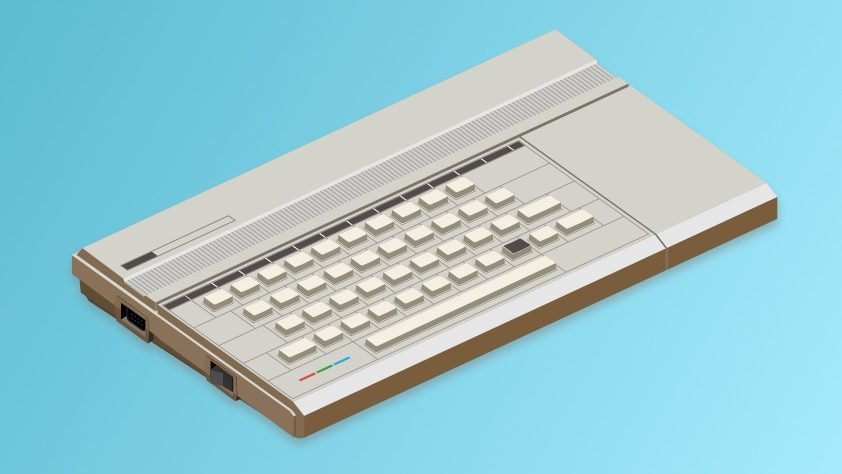
The Timex Sinclair 2068 was Timex Computer Corporation’s third and last home computer for the United States market.
Launched in November 1983, Timex improved on the ZX Spectrum by adding new features, including:
- an AY-3-8912 sound chip with three voices, whose I/O port also reads the joysticks
- two joystick ports
- a keyboard with hard plastic keys
- a cartridge port
- an improved ULA that offered additional screen modes:
- The standard Sinclair 256×192 mode with a color resolution of 32×24
- An extended color mode, 256×192 pixels with color resolution of 32×192
- A monochrome 512×192 mode
Advertisements described the TS2068 as having 72K (48K RAM + 24K ROM) of memory, color, and sound.
Although Timex Computer Corporation exited the home computer market in February 1984, an independent division continued to sell and develop the machine in Portugal as the Timex Computer 2068.
Timex/Sinclair 2000
Before Timex launched the TS2068, they showed the TS2000 to the press. The TS2000 was planned as two models, with 16K and 48K of RAM. Timex Sinclair User called them the TS2048 and TS2072; the May 1983 announcement and David Ornstein called the 48K model the TS2068.
According to David Ornstein, the “TS2000 [used] a Z80A microprocessor running at 3.5mhz. It [contained] a few buffers, either 2 or 6 RAM chips, 2 ROMs, and … a 64-pin custom chip.”
At the time, it wasn’t clear if the models shown to the press were mockups or operational. In Ornstein’s “Perceptions” column in the September/October 1983 issue of Sync, he stated that “I have been using the machine for about 10 months by now, 8-15 hours a day.”
Timex planned suggested retail prices of $199.95 for the 48K model and $149.95 for the 16K model.
A number of books about the TS2068 were written before Timex launched the TS2068 and refer to the TS2000 instead.
Announcement and Launch
Timex showed the TS2000 at the Winter Consumer Electronics Show in January 1983. Scott Mace of Infoworld reported delivery for the second quarter, cartridges under $25 and sales predictions of “hundreds and hundreds of thousands.” What the press saw was a ZX Spectrum in a restyled case: Computers & Electronics called it a Spectrum-style mock-up, and Creative Computing described 40 keys and no space bar. Unlike the Spectrum’s smooth top, the case had a “cooling fin” pattern across it; Timex later used this case for the TS1500.
On May 17, 1983 Timex announced a redesign with more memory, more characters on screen and keyword entry, still under $200. Syntax printed the key changes from the Spectrum (RESET, FREE, STICK, ON ERR and SOUND), a full space bar and a separate BREAK key. SYNC expected retailers to have it in August.
The schedule slipped. In August, Timex spokesman Carl Folta said only the 48K model would be made, and moved the release to mid-September. FCC approval took longer than planned; by October the FCC had approved the 2068 and Sears listed it in its Christmas catalog at $179.99. Early shipments sold well, with Sears reordering 4,000 units, but at Christmas T-S Horizons had seen it only at shows. Mail-order prices fell as low as $148.32 that November (Computers & Electronics).
At the January 1984 CES, Timex showed the peripherals it planned for the 2068: the TS2050 modem, the TS2060 expansion interface, the TS2080 80-column printer and the TS2065 Microdrive. Development from 1982 onward is traced in the site’s 2068 timeline, built from Timex’s internal documents.
BASIC
Sinclair BASIC was extended with new keywords: STICK, SOUND, ON ERR, FREE, DELETE, RESET. The computer used bank-switched memory, allowing ROM cartridges to replace or supplement the built-in ROM.
These changes made the 2068 incompatible with most Spectrum machine-code software (virtually all commercial titles). Spectrum ROM emulation, available in cartridge and supplemental ROM form, allowed users to run the majority of software produced for the Spectrum.
Most Spectrum BASIC programs load on a 2068, but most machine-language programs do not. Part of the reason is hardware: a Spectrum reads FF from an empty data bus, while the 2068 does not, and a pull-up resistor modification helps. Owners chose between the Romswitch, the Chameleon (EMU-1) cartridge and a direct ROM swap, compared in a LISTing chart. The Chameleon was said to run 95 to 98 percent of Spectrum software, and OMNI-EMU claimed 99.99 percent. Getting a Spectrum ROM image was its own problem; here is how users did it.
Resources
- Timex/Sinclair 2068 User Manual
- Timex Sinclair 2068 Beginner/Intermediate Guide by Fred Blechman
- Timex Sinclair 2068 Intermediate/Advanced Guide by Jeff Mazur
- TS2068 Memory Map and ROM Disassembly by Bob Orrfelt
- The Timex Sinclair 2068 ROM Manuscript by Dr. Lloyd Dreger
Operating System
The TS2068 features a 24K operating system that provided the Basic interpreter, full-channeled I/O facilities, and a function dispatcher that the user could call to have both simple and complex functions performed.
Bank Switching
Bank switching, a means of expanding the computer’s address space, was one of Timex’s main improvements over the ZX Spectrum. The TS2068 could theoretically access up to 256 * 64K, or 16 million bytes of memory.
In practice, the bank switching features supported extending the operating system with special cartridges like Zebra System’s OS64 or moving a BASIC program to cartridge, freeing the entirety of RAM for data.
Display
The TS2068 supports several different display options. They include:
- 32 column display
- 64 column display
- high resolution screen of 256 x 192 pixels
- high resolution screen of 512 x 192 pixels
The machine provides connections for a B&W or color TV, a composite video monitor and an RGB monitor. The last required an adapter.
Keyboard
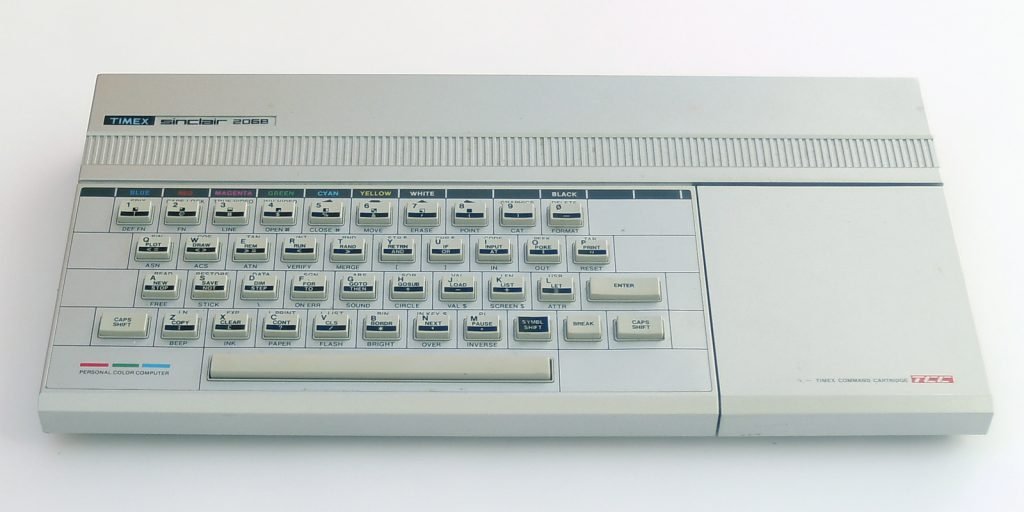
With the TS2068, Timex introduced a full-size keyboard with 42 hard keys, including a full-sized space bar and two shift keys, one on each side. Unlike the TS1000, it provides real tactile feedback.
Like the TS1000 and Spectrum, the TS2068 keyboard allowed entry of commands and functions with one or a few keystrokes. 26 keys directly entered commands like PRINT, LET, LOAD, SAVE, CLEAR et cetera. The Symbol Shift key gave access to 36 symbols and statements. Shift + Symbol Shift accessed even more and Shift + Symbol Shift followed by Symbol Shift and a key accessed even more.
To find the keys for any keyword or symbol, use the TS2068 Keyword & Symbol Finder.
All told, approximately 126 commands, functions, statements, symbols and graphics were entered via just a few keystrokes.
It’s debatable whether the feature was any faster than directly typing any of them. Given the way the edit window was refreshed with each keystroke, this method was a good compromise.
Like the TS1000 before it, the computer and popular press found the keyboard noteworthy. Neil Shapiro, in an article in Popular Mechanics (February 1984), referred to the keys as “chiclet” and noted that they were not “full-size typewriter key.” While they were not full-size, they certainly were typewriter keys: the 2068 shared its key style with the Brother EP-20 typewriter, as Fred Blechman noted.
Resources
The bank switching hardware and software was not fully debugged when the 2068 shipped. Several users have written about the hardware/software issues and proposed solutions.
- The Mystery of the Missing 253 by Wes Brzozowski, Time Designs, 1986–87: part one, two, three, four and the conclusion. He found only about two banks usable of the 256 promised, and the ROM limits itself to ten extra banks.
- Timex’s own pre-release memos planned fixes to the bank-switching code before the November 1983 ROM release.
ROM Bugs
- With a cartridge in the dock, machine code in the home bank does not run properly through USR, which the Programmer’s Cartridge Toolkit calls “a very serious bug.”
- Typing SAVE and pressing ENTER nine times crashes and resets the machine (Sinc-Link).
- Lists of bugs were printed by the Boston group and SIN, and Ray Kingsley produced a debugged EXROM.
Known Hardware Faults
- The SCLD causes about 60 percent of failures, from a dead keyboard or cassette to failed refresh of the upper bank, according to Victor Acuna, writing from Argentina, where some 5,000 machines were imported (Update).
- Burnt RAM chips are the most common repair, usually after powering up with a printer or disk interface attached (Time Designs). The switching regulator can fail under load and put 6–9 volts on the 5-volt line (Update); some owners replaced it with a linear supply.
- The 2068’s color-burst timing is not quite standard, which troubles some color monitors.
What Owners Discovered
- RGB. The RGB lines on the edge connector carry no sync, so a monitor needs a sync circuit: the Technical Manual’s, a ready-made board, or sync taken from inside the machine (Update, LISTing, Sinc-Link).
- Extended color. Real Gagnon published a toolkit for the 8×1 attribute mode (SUM).
- Touch-tone dialing from the AY chip (Time Designs).
- More memory. John Oliger turned a TS1000 RAM pack into dock-bank memory, and Larry Zunk added 32K for about $25.
- Disk drives. By 1991 about 1,700 disk interfaces had been sold for the 2068, more than 300 of them Larken and more than 600 Oliger, according to Don Lambert. Timelinez compared the systems.
Technical Specifications
- Z80A CPU at 3.528 MHz (a 14.112 MHz crystal divided by four; source)
- 24K ROM (16K BASIC, 8K EXROM with extensions)
- 48K RAM in six 4416 chips; the 16K that holds the display is shared with the SCLD
- AY-3-8912 sound generator (specifications, connector pinouts)
- Cartridge (dock) slot for ROM based software and other expansion devices
- 15V DC 1A power supply, center negative barrel connector; +5V comes from an internal switching regulator (details)
After Timex
Timex announced its withdrawal on February 22, 1984, less than three months after the 2068 became widely available. It cancelled the peripherals except the modem, and kept warranty support and its toll-free line. Estimates of how many 2068s had sold vary: a former Timex employee told the Boston group that 45,000 to 50,000 had sold by March 1984, with 10,000 to 15,000 more in Timex’s warehouses, while QZX reported that about 200,000 remained to be sold.
Prices fell below $100. Of the planned peripherals, the TS2020 recorder and TS2090 joystick shipped; 8,000 TS2050 modems were built but never left the warehouse under Timex, and the TS2080 printer was never produced. In June 1984 Timex Materials Sales in Little Rock began selling the schematic and Technical Manual for $25 (review), and TS Connection of Cincinnati took over factory repairs.
Timex Portugal
Timex Portugal, independent of the American division, went on making the machine as the TC2068. It kept the 2068’s keyboard, ROM, joystick ports, sound and cartridge port, and added a Spectrum edge connector and a 9-volt supply in place of 15 volts. SUM‘s hands-on review found it shipped with a Spectrum emulator cartridge; a look inside counted 14 chips instead of 18, a linear regulator and a louder speaker driver.
In 1985 the TC2068 was sold in the United States for $159.95, and the Portuguese disk drives work with the TS2068 without an emulator (LISTing; owner review). Portugal also sold the TC2048, with a chiclet keyboard and no cartridge port (Sinc-Link). Newsletters reported large sales to Eastern Europe, with figures from 200,000 to 800,000 units, but these were never confirmed.
Further Reading
- Timex 2068 Technical Manual, by M. H. Branigin and V. Carole Corcoran
- Technical Memo #0005: Advanced Video Modes, with #0004 and #0006
- Timex Sinclair 2000 Third Party Software Guide
- First Look at Timex/Sinclair’s New Color Computer, Fred Blechman, Computers & Electronics, November 1983
- The Rise and Fall of the Timex Computer Corporation, Tim Woods, Time Designs, 1984 (part 2)
- 2068 timeline and A Computer in Search of an Audience, a survey of the period’s reviews
References
- Ornstein, David. “Perceptions.” Sync v3n5, September/October 1983 (scan).
Communities
- TS2068@groups.io – email list of 2068 fans
- Timex/Sinclair Place – public group of T/S fans on Facebook
- Timex Sinclair Nostalgia – another public group on Facebook
Links
Frequently Asked Questions
What kind of power supply do I need?
The 2068 needs a 15 volt, 1 amp power supply with a center negative 5.5/2.5mm (.218/.097 inch) barrel connector. You can find suitable center positive power supplies at places like Amazon and eBay; here’s an example. You will also need a “polarity reverse” cable to convert a center positive supply to work with your 2068.