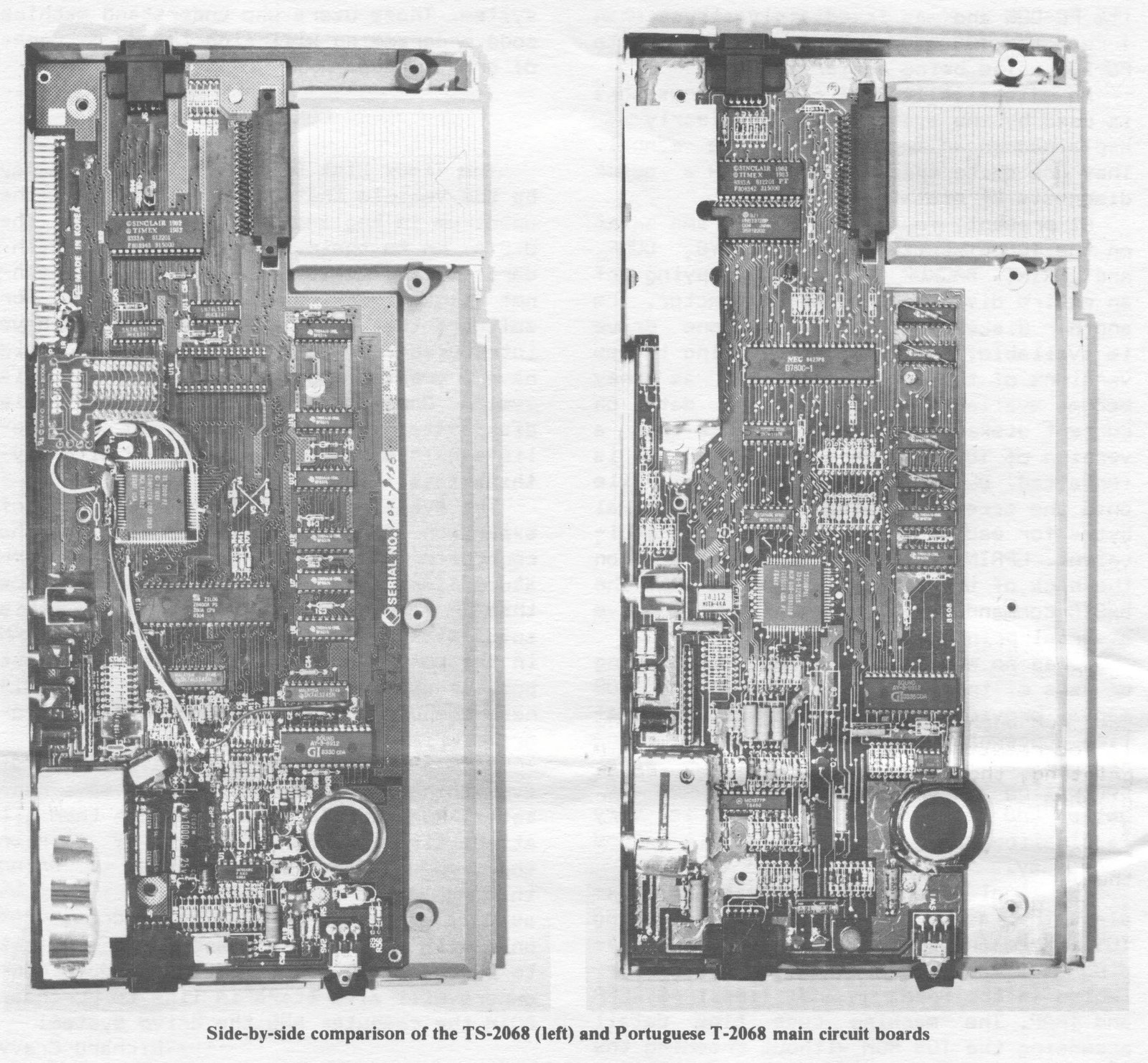
Disassembling the T-2068 reveals a circuit board smaller than found in the American computer. It is a very professionally designed board with no wire jumpers. A stand alone RF modulator replaces the video/RF modulator circuitry of the TS-2068. There are no trim pots or adjustable components except for a fine tune in the RF modulator. By comparison, the TS-2068 has five adjustable components.
The integrated chip count is down to 14 from 18 in the TS-2068, and none are socketed. Gone are the ICs which buffer the address and control lines; gone is the switching regulator IC, replaced by a 5 volt regulator and a very large heat sink as found in the Spectrum+. The speaker has a new chip driving it, the popular LM 386, and the sound is louder. The SCLD chip looks the same but following the circuit board traces indicates that it is probably ditferent–bad news for owners who might have wanted to swap theirs for this one.
The rest of the components on the computer circuit board are about the same and in the same general location with the exception of the 5 volt regulator and the Z80 cpu. The ear and mic jacks are like those on the TS-1000 and Spectrum series; they are not as sturdy but work fine. The keyboard has more spring and fewer dead spots than the TS-2068. The circuit board itself is stamped “Timex 2068A”; compare this to my TS-2068 which says “Timex TS 2000”. The boards seems to be one model behind the machines they are in!
The big question is how ‘compatible’ is the new T-2068 with the English Spectrum and the American TS-2068. The answer is: VERY! I was able to run MScript with its 64 column mode as well as Musicola and Cyberzone and the computer ran like a TS-2068. Next I inserted the Spectrum Emulator cartridge that comes with the T-2068 and loaded all the Spectrum software I had. No problems! The emulator boots up differently than Doug Dewey’s EMU 1. Doug’s shows first the 2068 copyright and then switches to the Spectrum copyright. The T-2068 emulator boots directly to the Spectrum copyright notice.
What about hardware compatibility? The T-2068 has a Spectrum edge connector so should handle anything made for the Spectrum by using the emulator cartridge (Rotronics Wafadrive, Sinclair Interface I and II). The Timex 2040 printer works fine as does the 2050 modem and Tasman printer interface. The Aerco interface works fine on my printer, but may give problems since it looks for the RESET line, which is not in the same location on the T-2068 and Spectrum edge connectors. Since this line is for resetting your printer to begin printing, the same thing may be accomplished by simply turning off your printer and then back on before sending to it. The FootePrint interface described in SUM in the January thru March issues does well and so does the Timex 2020 tape recorder.
I believe the A & J Microdrive will work if a “twister board” is designed to make the edge connector look like the T5S2068.
In the May-June issue of LIST (Long Island Sinclair Timex Newsletter, P. 0. Box 438, Centerport, NY 11721) Nazir Pashtoon also reviews the Portuguese T-2068. He has already figured out the rear edge connector pin-outs, specifically those which extend beyond the Spectrum (the T-2068 has more pins on its edge connector than the Spectrum, just like the TS-2068). EXROM, BE and RGB signals are still present on this new buss. Missing are ROSCS, SPKR TAPE OUT, SOUND, IOA5, and EAR. Added is a stripped sync signal for an RGB monitor making a direct hook-up to an RGB monitor possible. Connecting the proper pins to my Sears RGB monitor gave beautiful results without having to make any extra circuits. Pashtoon’s unit apparently was a rough pre-production unit as it had a “rigged” color video circuit, extraneous bypass capacitors, and all its chips in sockets. Nazir did test the Sinclair microdrives on his model T-2068 and reported that they worked perfectly.
Opening all three of the system boxes shows clean, professionally designed and produced circuit boards. I only found one jumper wire.
The power supply is double-fused and well regulated. Our unit got a little hotter than I like, but did not affect its operation. It is necessary to always put it where it can get plenty or air circulation to prevent possible overheating. Inside the disk controller I found a very familiar circuit board–the board from the TS-1016 RAM pack for the TS-1000! It still has the Sinclair logo and (fiat ribbon cable. The engineers were resourceful! The controller is basically a self-contained computer, having its own Z-80 cpu, memory (16k + 1k), and 1k ROM. For the two RS-232 ports on its backside, a UART (universal asyncronous receiver/transmitter) is used. A disk controller chip and a “mystery” ULA chip completes the board.
Having the on-board RAM means the controller does not take up any computer RAM. This enhances software compatibility and distinguishes it from the Rotronics Wafadrive, Sinclair Microdrive, and several disk drive systems available in England for the Spectrum. A label on the bottom of the controller refers to CP/M. Since only the ROM was socketed inside, perhaps it will be changed and extra memory added for CP/M compatibility later.
Inside the disk drive box is a Hitachi 3″ drive. The disk unit is very sturdy and solid looking; I suspect it will be very reliable. A set of jumpers at the back of the drive allows configuring the drive as number 1, 2, 3, or 4 in a system.
The two interfaces supplied with our unit allowed us to run the disk drive system with both the Spectrum+ and the T-2068. A third interface is promised to allow the TS-2068 to also run the drive system. We were able to accomplish this by using a twister board modified according to Nazir Pashtoon’s instructions in LIST and then plugging into the TS-2068 interface. Voila! Disk drives on the American TS-2068!