
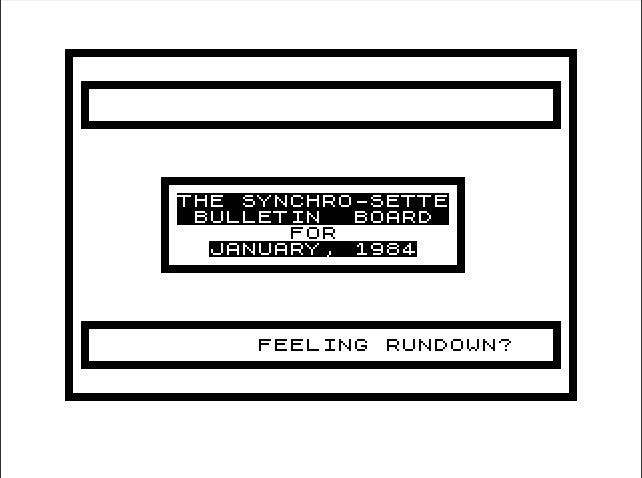
A scrolling news display for the January 1984 issue. A framed title panel sits between two one-line windows, and each window scrolls its own message across the screen in turn. Pressing P pauses the scroll, B runs it backward and F forward again.
The messages are stored in string variables saved with the program. The first reports that Timex is building the TS-2068 in small numbers to keep its price up, that another TS-1500 production run is planned for early 1984, and that TS-1000s with a 16K RAM pack are being cleared through a national distributor for about $30. It also mentions printers, microdrives and modems that Timex had announced but not yet shipped. The second advertises Pixie, a hi-res graphics product for the 2068, offers back issues of Synchro-Sette from 10/82 at $8.00 for two issues with cassette, and ends with a short joke news item.
Program Analysis
Program Structure
Lines 100–140 print three stored block-graphic strings down the screen, then lines 150–260 draw the outer frame, the title panel and the two message boxes. Two scrolling loops alternate between the windows: 3000–3090 show the top message A$ on row 3 and 3100–3190 show the bottom message B$ on row 18. Each loop prints a 28-character slice A$(N TO N+27) and moves N on by one each pass. The reverse routines at 3200 and 3300 step N back toward 1.
Notable Techniques
- The program is started with
GOTO 100(line 9999) instead ofRUN, so the message strings in the saved variables are not cleared. - Each message starts and ends with a long run of spaces, so the text scrolls in from the right edge of the window and off the left.
Potential Issues
- The loops stop at
LEN A$-32while each slice is only 28 characters wide, so the last four characters are never shown. Because the messages end in spaces, nothing is lost.
Image Gallery
Source Code
 100 FOR N=0 TO 17
 110 PRINT AT N,2;S$;AT N,0;U$
 120 PRINT AT N,6;T$;AT N,0;U$
 130 PRINT AT N,5;V$;AT N,0;U$
 140 NEXT N
 150 FOR N=1 TO 30
 160 PRINT AT 0,N;"▀";AT 21,N;"▄"
 170 NEXT N
 180 FOR N=1 TO 20
 190 PRINT AT N,0;"▌";AT N,31;"▐"
 200 NEXT N
 210 PRINT AT 0,0;"▛";AT 0,31;"▜";AT 21,0;"▙";AT 21,31;"▟"
 220 PRINT AT 9,6;"▌[T][H][E]█[S][Y][N][C][H][R][O][-][S][E][T][T][E]▐";AT 10,6;"▌█[B][U][L][L][E][T][I][N]██[B][O][A][R][D]█▐"
 230 PRINT AT 11,6;"▌       FOR       ▐";AT 12,6;"▌  [J][A][N][U][A][R][Y][,]█[1][9][8][4]  ▐"
 240 PRINT AT 8,6;"▛▀▀▀▀▀▀▀▀▀▀▀▀▀▀▀▀▀▜";AT 13,6;"▙▄▄▄▄▄▄▄▄▄▄▄▄▄▄▄▄▄▟"
 250 PRINT AT 2,1;"▛▀▀▀▀▀▀▀▀▀▀▀▀▀▀▀▀▀▀▀▀▀▀▀▀▀▀▀▀▜";AT 3,1;"▌";AT 3,30;"▐";AT 4,1;"▙▄▄▄▄▄▄▄▄▄▄▄▄▄▄▄▄▄▄▄▄▄▄▄▄▄▄▄▄▟"
 260 PRINT AT 17,1;"▛▀▀▀▀▀▀▀▀▀▀▀▀▀▀▀▀▀▀▀▀▀▀▀▀▀▀▀▀▜";AT 18,1;"▌";AT 18,30;"▐";AT 19,1;"▙▄▄▄▄▄▄▄▄▄▄▄▄▄▄▄▄▄▄▄▄▄▄▄▄▄▄▄▄▟"
 270 GOTO 3100
3000 LET A=1
3005 FOR N=A TO LEN A$-32
3010 PRINT AT 3,2;A$(N TO N+27)
3020 IF INKEY$ ="P" THEN PAUSE 40000
3030 IF INKEY$ ="B" THEN GOTO 3200
3090 NEXT N
3100 LET A=1
3105 FOR N=A TO LEN B$-32
3110 PRINT AT 18,2;B$(N TO N+27)
3120 IF INKEY$ ="P" THEN PAUSE 40000
3130 IF INKEY$ ="B" THEN GOTO 3300
3190 NEXT N
3199 GOTO 3000
3200 LET A=N
3210 FOR N=A TO 1 STEP -1
3220 PRINT AT 3,2;A$(N TO N+27)
3230 IF INKEY$ ="P" THEN PAUSE 40000
3240 IF INKEY$ ="F" THEN GOTO 3270
3250 NEXT N
3260 GOTO 3000
3270 LET A=N
3299 GOTO 3005
3300 LET A=N
3310 FOR N=A TO 1 STEP -1
3320 PRINT AT 18,2;B$(N TO N+27)
3330 IF INKEY$ ="P" THEN PAUSE 40000
3340 IF INKEY$ ="F" THEN GOTO 3370
3350 NEXT N
3360 GOTO 3100
3370 LET A=N
3399 GOTO 3105
9997 STOP
9998 SAVE "BULLETI[N]"
9999 GOTO 100
Note: Type-in program listings on this website use ZMAKEBAS notation for graphics characters.