
The Sinclair ZX81
Dilithium Press
8285 SW Nimbus, Suite 151
Beaverton, OR 97005
$11.95 ($24.95 with cassette)
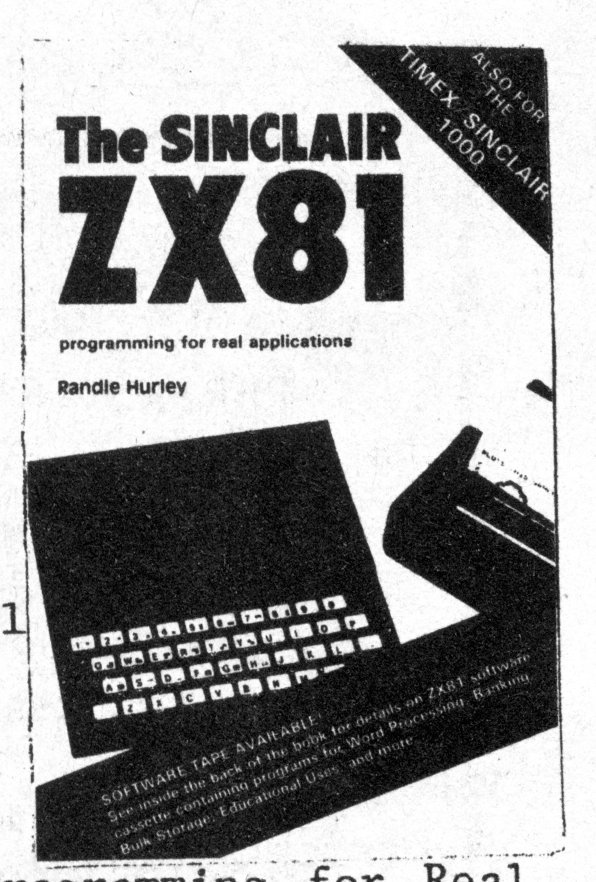
“The Sinclair ZX81 – Programming for Real Applications,” may not be the most recent book written for the ZX81 and TS1000 computers, but it is instructive and well-written, and would make a fine addition to anyone’s Timex-Sinclair-related library. The book is intended for the new user who is ready to go beyond the Sinclair manual, yet it has material of interest to more experienced programmers as well. The author, Randie Hurley, covers a range of several practical applications including word processing, bulk data storage, test scoring and analysis and financial applications. The program listings are presented interspersed with text and are extensively documented. All the programs (which are available on tape) require 16K RAM.
However before presenting the applications, Hurley spends two chapters on an excellent discussion of programming techniques. Chapter 2 begins with a succinct introduction to flow charting. (All the major programs are accompanied by flow charts.) The chapter also provides routines for input checking, auto start-up and crash protection. Program de-bugging and a”dry-run” technique are also discussed.
Chapter 3, Saving Time and Space, begins with a comparison of integer, decimal, and binary number manipulation as an introduction to a discussion of memory-saving techniques and running and loading time saving techniques.
The Word Juggler (Chapter 4) is a menu-driven mini-word processor, complete with cursor controls (on the arrow keys), and limited delete, correct, and insert capabilities. The program is in BASIC (as are all the programs in the book), and takes about 3.5K of memory, leaving room for approximately 2000 words. There is an optional “readability calculator” which computes the reading difficulty of the text by paragraph. This subroutine is valuable for teachers and others who need to gear their work to a particular age group or intellectual level. The Word Juggler is written for use with the 32-column ZX (thus TS 2040) printer.
Chapters 5 through 7 contain programs and subroutines for financial applications, including a bill payment/checkbook balancer, a dollar (or pound) format subroutine, and a bank program. The latter is a program developed by Mr. Hurley for use at a “student bank” in a school where he teaches in England. It can handle 200 accounts and handles various transactions, opens and closes accounts, calculates earned interest, and does general accounting.
Chapter 8 discusses a clever technique for the bulk storage of large amounts of data.
Chapters 9 and 10 have teacher aids like a “Rank Order” program to rank students by test scores, and a Exam Result Analyzer to evaluate test scores by overall performance, individual subjects, random samples and other considerations.
Hardware Modifications, Chapter 11, seems oddly out-of-place in this programming book. Two of the projects are obsolete, dealing with the ZX80 and the ZX81 kit. The third is on linking a “normal keyboard” to the ZX81, and provides several helpful hints for doing so.
The book does what it is intended to do, which is to take the Sinclair user beyond the owner’s manual, and mostly to offer real world applications for the ZX81. Hurley’s eclectic writing style gives the book a comfortable feel.