
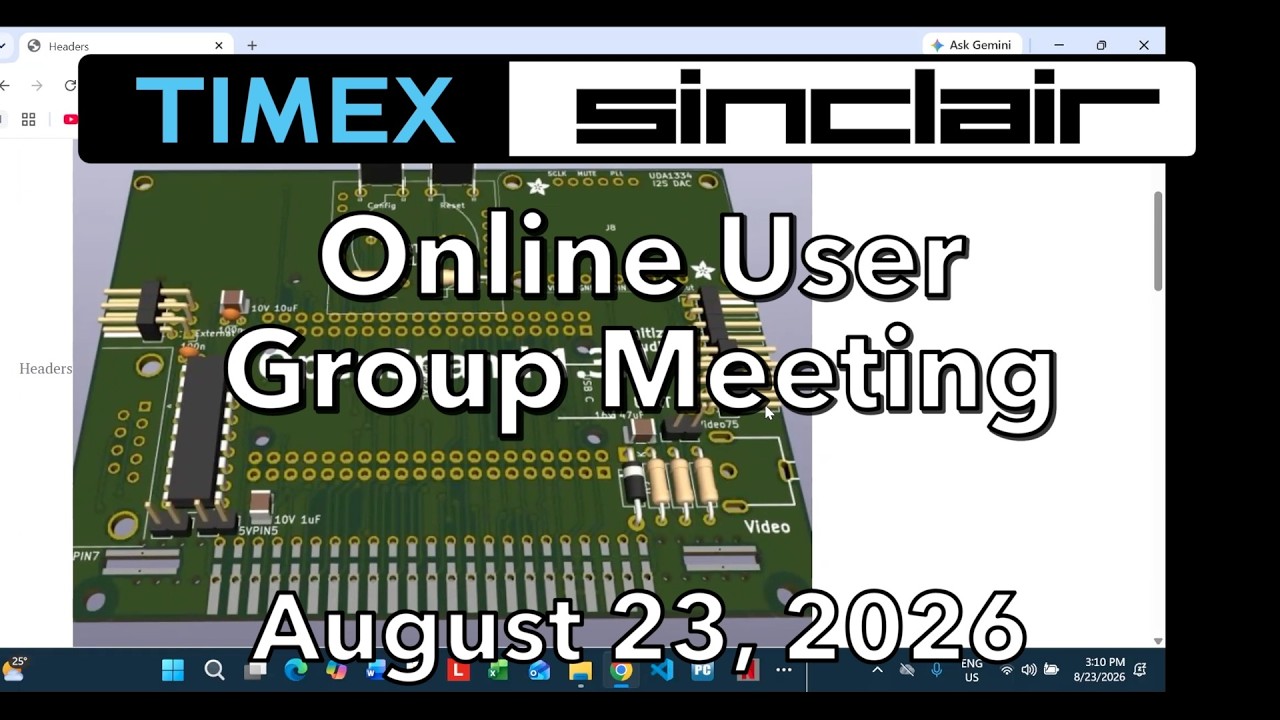
Jon Becker spent the past few weeks pushing AI coding tools as far as they would go on the 2068, and the results dominated the meeting. Working mostly in Codex, he converted VU-3D and then ported the Spectrum version of Elite to a 64K 2068 cartridge with a title screen, already posted to the group list. Most of the work was hands-off: once Codex had a workflow for driving the Fuse debugger, it set its own traps, ran code traces, and resolved crash bugs and ROM incompatibilities on its own. He also has an extended-color-mode video codec that takes a short video and emits a delta sequence as either a tap file or a 64K cartridge, storing a compressed key frame and using a FIFO packing method that lets deltas cross 8K bank boundaries — roughly 56K of usable space. Jon is also fabbing a cartridge-sized ROM emulator. He bought a PicoROM board, an open hardware RP2040 design in a 28-pin EPROM form factor, confirmed it works in a 2068 cartridge, and is now merging that layout with his own onto a single surface-mount board with a USB port on the side for reprogramming. The goal, Jon said, is to make them cheap enough to leave lying around like original cartridges.
Stewart Newfeld gave a long screen-share tour of the OpenSpand, a Pico 2–based add-on for the TS1000 that provides tape file system from SD card, a real-time clock, digital audio, and composite video. The group also looked at a second OpenSpand variant on Tindie from Don Crawford and David Spinnett, sold as the 1526, which drops the real-time clock and sound module, adds a joystick board, and hides a micro SD slot inside the handle of a 3D-printed cartridge so only eight fingers are needed on the edge connector. Gustavo Pane pointed out how closely the case resembles the Timex Portugal M397 interface, and noted the 1510 predates the FDD3 by two years, the reset button and fake cooling vents line up, suggesting a reused mold.
An extended tangent on 1983 cartridge pricing produced hard numbers from catalog scans: Androids was $20 on cassette and $35 on cartridge, Penetrator $20 and $40. Classic Computer Magazine put cartridges at $29.95–39.95 against $9.95–19.95 for the same titles on tape, steep on a machine that cost $200.
David demonstrated SpaceTrader, a merchant trading game built on Traveller’s rules that Claude wrote for him over a couple of days, with a light chance of running into a pirate. It runs mostly in BASIC with machine code for the screen drawing, and it leans on Jon’s extended color mode: each of roughly twenty systems gets its own ECM image across the top third of the screen, generated in Midjourney after some prompt wrangling to get the resolution low enough. Until Jon started exploring ECM, David noted, Frogger was about the only thing that had ever used it.
David then showed the first issue of Syntax from 1980 and an ad for the Presto Digitizer, a roughly $70 drawing tablet announced for the ZX80 that never shipped for it; a later issue explained it needed the 8K ROM. Its designer, David Thornburg, had been a research scientist at Xerox PARC and went on to co-found Koala.
Ryan Gray closed with his ULA plus work on Jeff Burrell’s PicoVideo card. ULA plus steals the flash and bright bits to give four palettes of ink and paper colors, nominally 64, but because a character cell carries only one flash and bright combination, colors from different palette groups can never appear together in the same cell. Ryan wrote a palette editor in BASIC to tune values by hand and is working on gamma correction to map colors more predictably.