
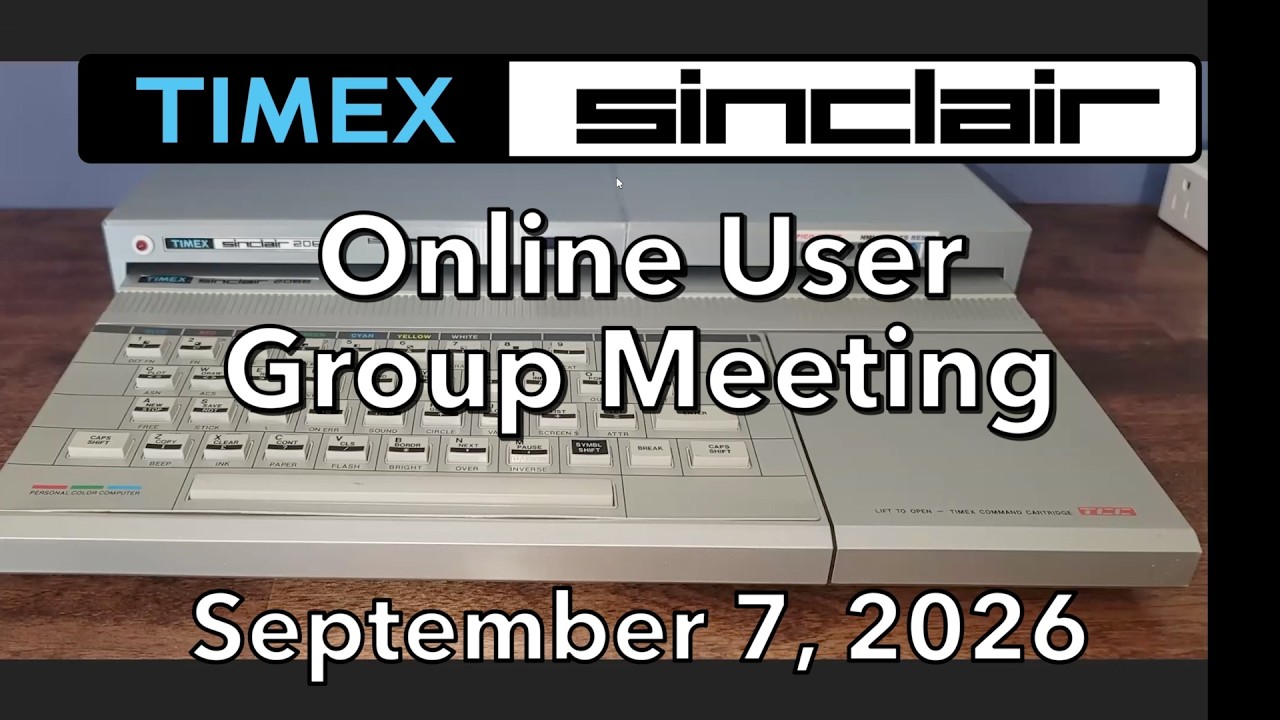
Charlie opened with the new 2068 ROM he went from announcing on the mailing list to working code in about a week and a half. He wanted a real kernel underneath it, and a language that looked like the SuperBASIC he had loved on his QL, so there are no line numbers, only labels and a label table, which sidesteps the classic 2068 problem of GOTO scanning memory from the bottom every time. He built it with Claude first, then brought in Codex when he hit roadblocks, feeding both the hardware references and his own kernel design.
The same kernel already runs a Forth ROM, public on GitHub and fully workable, and that Forth — which fits both integer and floating-point arithmetic into the home ROM without touching the EXROM — is now the basis of a hybrid he is building, with an external keyword library so new BASIC keywords behave exactly like built-in ones.
Josef Jelinek demonstrated the browser-based TS2068 emulator behind TSRun. It loads under 100 kilobytes in the browser, ROMs included, and was wired up to archive.org about a week after David filed a pull request asking for it.
Josef walked through the internals: WebGL rendering where every pixel is a rounded dot that blends with its neighbors to fake a very good CRT, integer-only scaling when the CRT filter is off, a background audio thread mixing ULA and AY clock-accurately, and turbo tape loading that detects the ROM’s polling pattern and runs a hundred frames for every one it paints, emulating the ULA port reads rather than hacking the ROM.
Jon Becker released the Berserk cartridge, a direct conversion helped along by the arcade original being Z80-based. The hard part was speech. He worked up from Tad Painter’s one-bit implementation through four-bit AY, then wrote a converter that fits combinations of AY square-wave harmonics to the original audio and plays back the AY parameters at 60 Hz, leaving enough time between frames for game mechanics.
That converter is now its own project, speech2ay, with a demo embedded on its GitHub page that runs in TSRun and lets you hear one-, two- and three-channel versions side by side.
All of which fed a long thread about what the tools change; Josef argued the point is not that these machines can now be programmed but that projects actually get finished.
David shared the TS2068-Ref-Library he has put on GitHub: ROM disassemblies, the technical manual and more, mostly in markdown, for exactly the situation where you are arguing with Claude about how the 2068 actually works.
Jeff Fetta reported back from VCF Southeast, which drew a good crowd. His table ran from an MTX 512 through a QL, a Spectrum with a Harlequin board, the 2068 and a ZX81 with a Memotech RAM pack, plus a modem.
VCF Midwest was the following coming weekend in Schaumburg, with about ten people expected: Jeff, Joe VandeZande, Mowgli Assor, Carl Miles, Stuart, David Green, John Mark Mobley and others.
Paul brought the sad news that Frank Davis died in July. The two met at the 1986 Cincinnati fest, after which Frank started the Indiana Sinclair Users Group and its newsletter, and the pair went into business as Mechanical Affinity. Paul had a background assembling and soldering things, and the venture really got going when Tom Bent decided to sell out and offered them his inventory, mostly QL.
Mechanical Affinity ran until about 1991 or 1992, after which Frank moved toward the Amiga while still producing his Timex publications by desktop publishing on a QL. He was also a rural mail carrier and a postal inspector.
Francois Lanciault will exhibit at the Vintage Computer Festival Montreal on November 7 and 8, staging a deliberate contrast between a 2068 and a 1982 HP industrial machine he benchmarks at roughly 450 times the speed of the IBM PC. He is also bringing the TS-Pico and rare QL hardware, and was startled to find a second Timex exhibitor on the registration list, Andrew Bocchicchio, after assuming he was the only one in Quebec.