
A SINCLAIR IBM “CLONE”?
Late one morning in the TDM office, I received a rash of phone calls, one right after the other, and all concerning the same thing. An anxious voice on the other end of the line would ask, “have you seen the new Sinclair computer advertised in POPULAR SCIENCE magazine?” Then sounding as if a friend had betrayed them, they would add, “it’s an IBM clone”.
I admitted that I hadn’t heard about it or seen one (but thought to myself it sounded a bit fishy). By about the third or fourth call from one of our customers, I had my coat in hand, and was headed down to the drug store to secure a copy of the magazine.
And sure enough, towards the back of the publication was a full page ad with a black and white photograph (see example) showing a complete computer system including a monitor, a printer and a mouse. The logo depicted on the equipment was unmistakable. The familiar black and white Sinclair trademark.
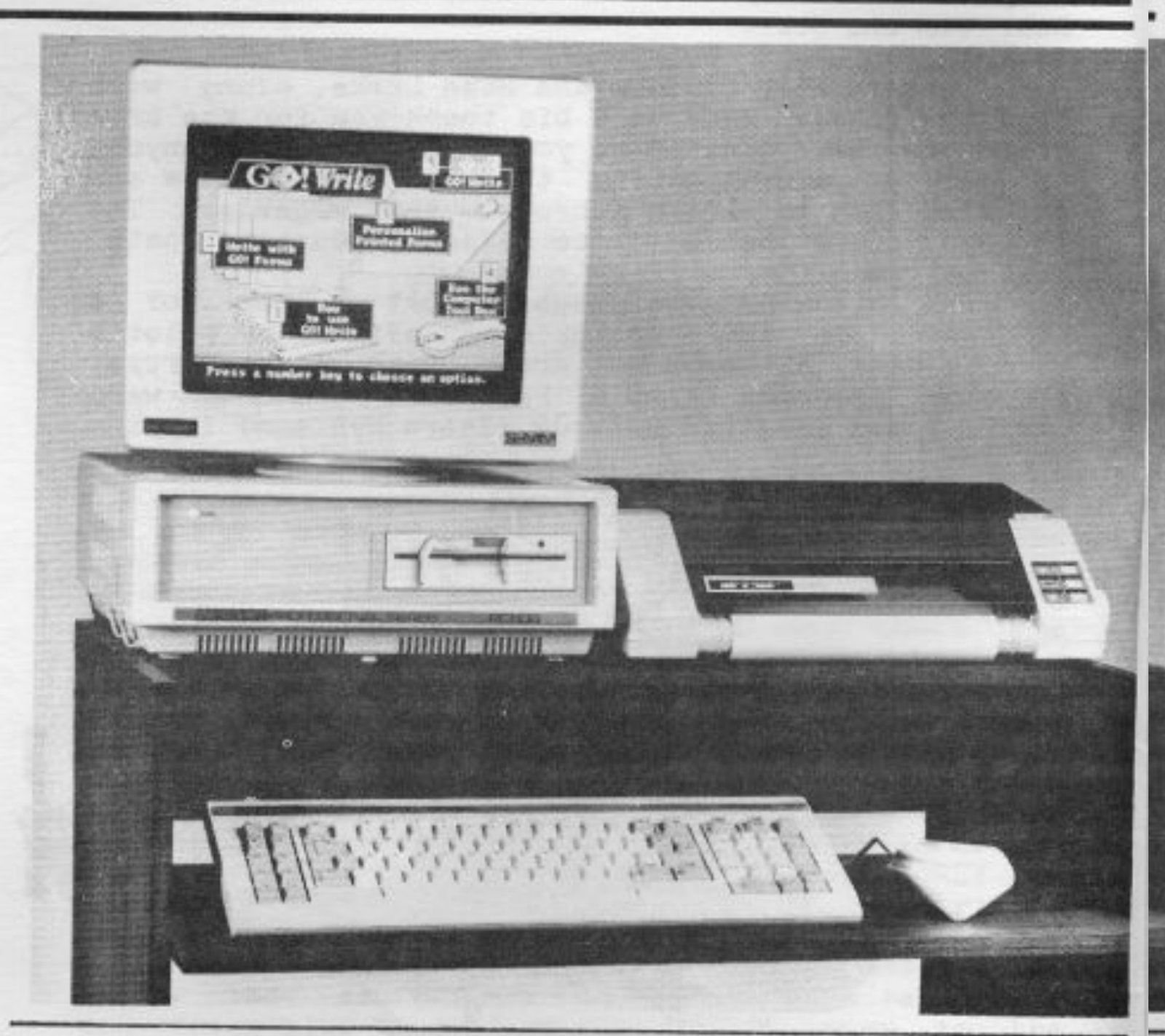
But wait. There was also something familiar about that computer. It looked suspiciously like an AMSTRAD PC-1640.
It wasn’t until a month later, that I heard the complete details behind this mystery computer. It was at the Midwest Sinclair Conference in Cleveland, Ohio, during a lecture by Nigel Searle (a business associate and personal friend of Clive Sinclair).
Nigel told the audience that when the Z88 portable computer came to the U.S., the national distributor took on the business name of “SINCLAIR SYSTEMS INC.”…until, that is, lawyers from AMSTRAD showed up. They said, “no way…we hold the exclusive world-wide rights to the SINCLAIR name”.
Indeed, back in 1986, Clive sold his computer company to save his faltering research organization. But through some hazy clarification, Clive thought that the deal signed with AMSTRAD only included the exclusive use of the Sinclair name in Europe. But AMSTRAD, and it’s shrewd chairman, Alan Sugar, had other ideas.
To avoid a nasty legal battle, the Z88 distributor instead elected to use the simple initials, “SSI”. But it was reported, that Alan Sugar and AMSTRAD still harboured ill feelings toward Clive, thinking that he somehow tried to cheat them.
It was at the Chicago Consumer Electronics Show, that this clash came to a head. By chance, AMSTRAD and SSI had adjoining booths. Both Nigel Searle and Clive Sinclair were there to promote the Z88.
When they looked over at the AMSTRAD booth, they couldn’t believe their eyes. Right out in front was one of AMSTRAD’s Korean-made PC clones. And where the logo should have been, somebody had taken the old Sinclair logo (literally cut out of a magazine or brochure), and had scotch-taped it over the AMSTRAD logo!
It was very obvious that Alan Sugar was trying to “punish” Clive Sinclair. It is well known that Clive has never had any desire to produce an MS-DOS machine. Just look at how non-conforming the Sinclair computers have been, right down to the black plastic cases (no beige here).
Originally, the sale of his computer company and certainly the use of his name by a competitor, bothered Sir Clive a bit. But now, looking at these “disguised” computers, both Nigel and Clive chuckled out loud.
So thus the story of the Sinclair “clone”. However, we did hear from a reliable source, that AMSTRAD will market this “new” computer, banking on increased sales, even though both the similar AMSTRAD model and the re-packaged “Sinclair” model will both be sold simultaneously here in the U.S. Supposedly the AMSTRAD PC stock hasn’t moved to Alan Sugar’s liking. With the Sinclair version, he is counting on name familiarity.
Will the old TS1000 and ZX-81 owners (at one time, nearly a million strong) be fooled by this “wolf in sheep’s clothing”?
- Tim Woods
SUMMER T/S SHOWS
Small crowds, large exhibitor displays, and excellent guest speakers, marked the opening of summer Timex Sinclair computer shows in two different geographical locations.
The Third Annual Northwest/International Timex Sinclair Mini-Fair “kicked off” on August 6 and 7, at the Cosmopolitan Hotel in Portland, Oregon. The event, produced by Rod Gowen, was organized and structured very professionally, and was compared in some aspects to the Indianapolis Timex show held last year.
Ed Grey (Ed Grey Enterprises) demonstrated modems, serial cards, and digitized video. Sharp’s Inc. had a full spread of QL and Z88 items. RMG Enterprises featured printers, monitors, and disk drive systems stacked shoulder high. But Zebra Systems had the largest display, with ten tables full of TS1000 and TS2068 merchandise.
Nigel Searle, representing SSI and promoting the new Z88 portable computer, shared a booth with George Whitham of A+ Computer Response. Jack Dohany had a customized work station that allowed him to produce 2068 software for a variety of systems and disk drive formats. Time Designs and Foote Software also had some displays.
Not to be out-done, the users groups provided some interesting things to look at. At the CCAT/S booth, Ed Fry demonstrated his four-port expansion decoder for the TS1000 (see his article on the decoder in this issue of TDM). Another TS1000 operated a Radio Shack robot arm at the SEATUG booth. VISTA demonstrated a Larken disk drive system and provided information on a public domain software exchange. Both the Vancouver and Las Vegas groups provided newsletters and information about their groups activities.
Guest speakers in the seminar room included Jack Dohany, Mike de Sosa, Wilf Rigter, Ed Grey, Harvey Taylor, Michael Carver, Nigel Searle, Vince Lyon, and Dick Wagner.
Late Saturday night, a special “Round Table” session was held (open to the public), with many of the guest speakers presiding, fielded questions from the audience. Several computer topics were discussed, including “shareware”, copy protection, software piracy, computer viruses, the Z88 portable computer,
a telecommunications network proposal, and S.N.U.G. (Sinclair Northamerica Users Group…an idea originally initiated by some individuals at the computer fest in Florida).
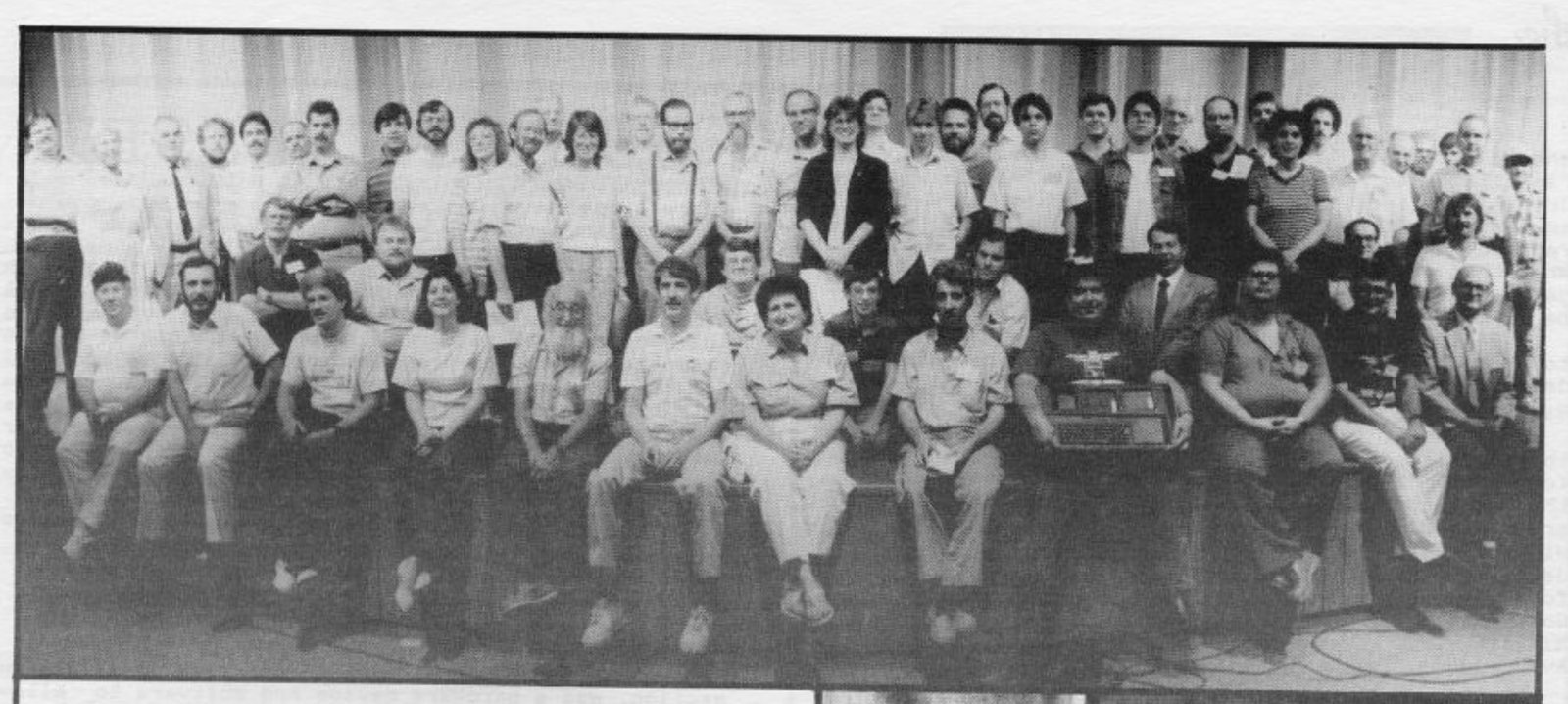
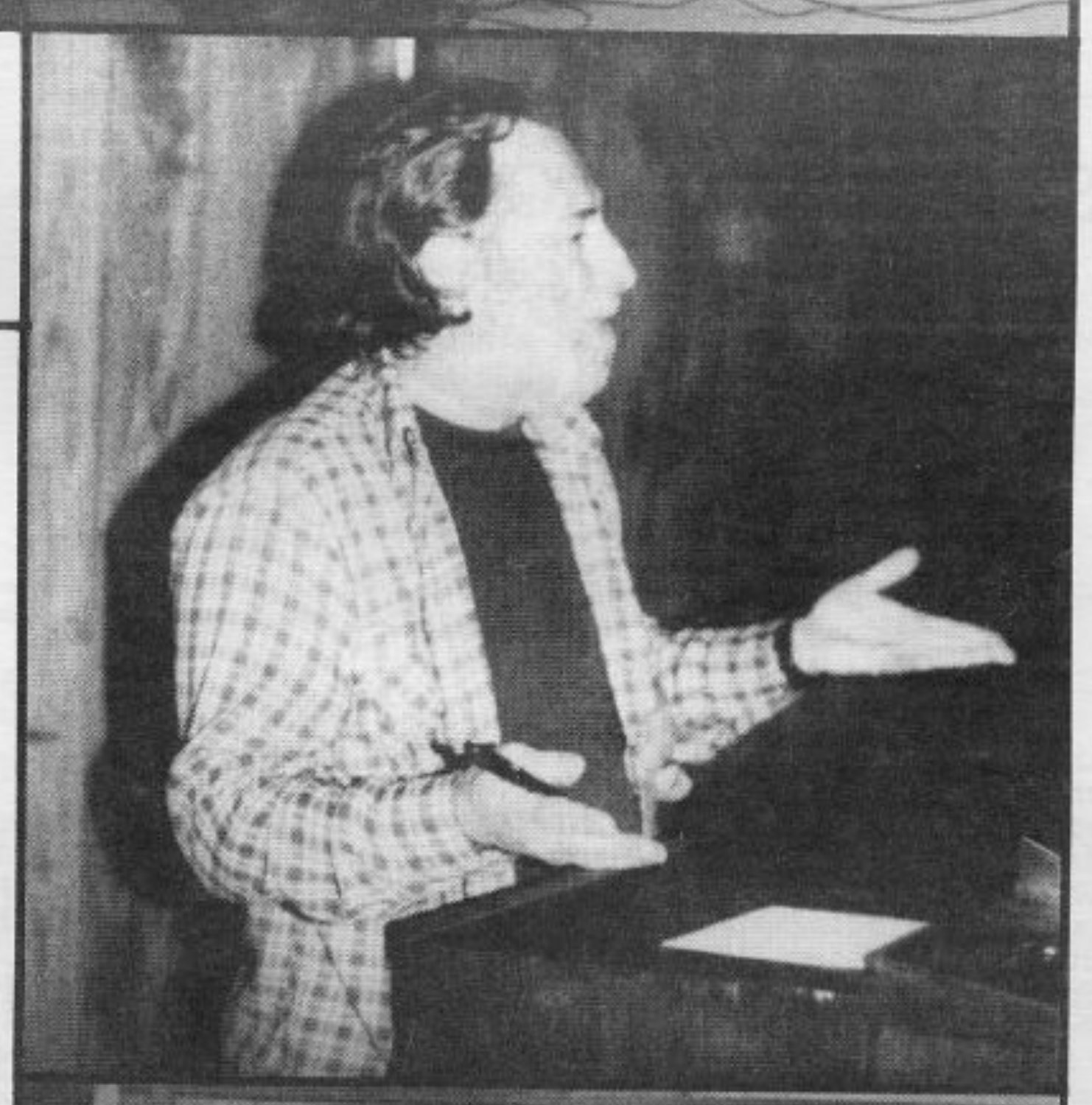
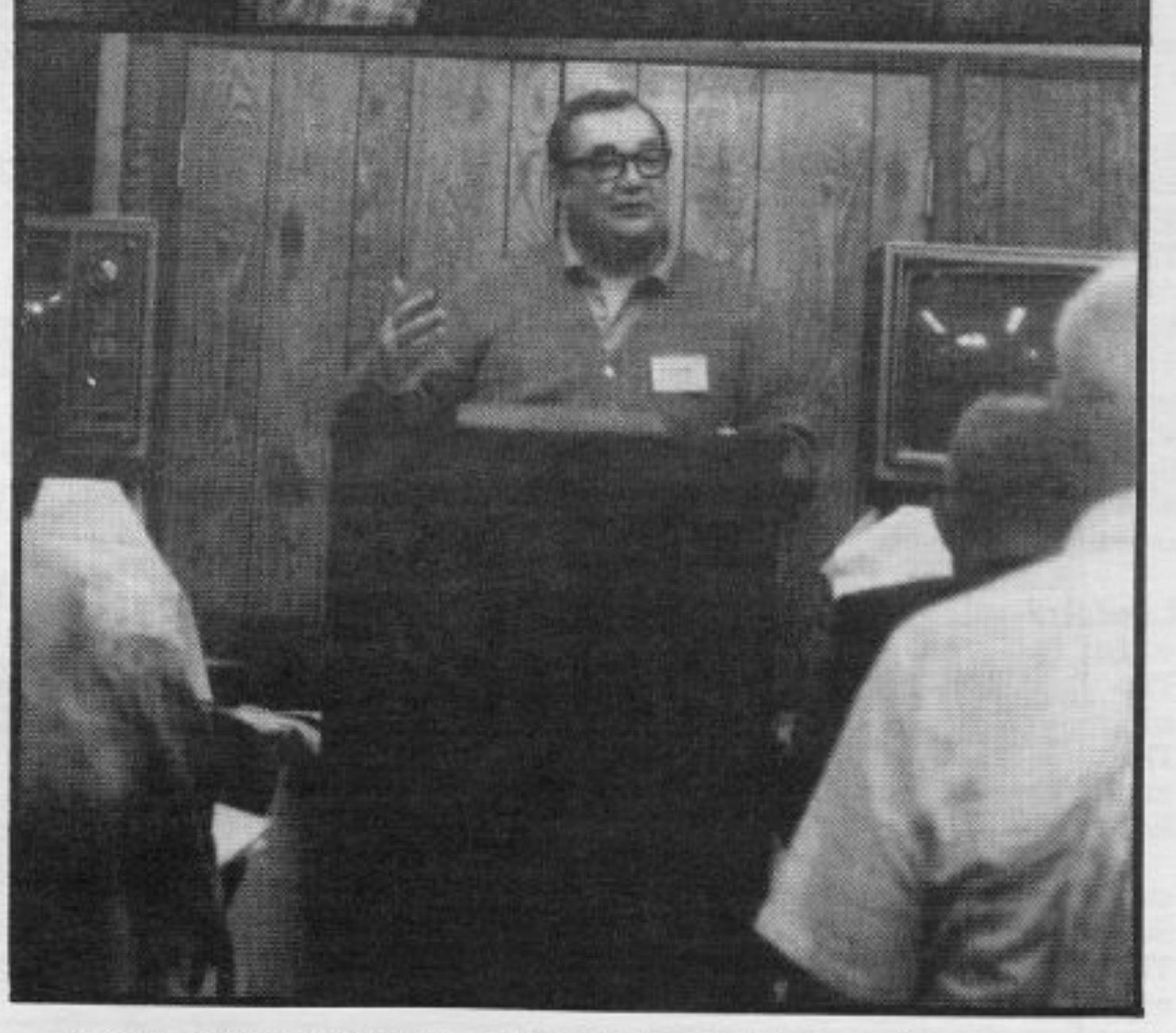
TOP: Timex/Sinclair users who participated in a special meeting on Saturday night in Cleveland, Ohio. One of the topics discussed was the feasibility of S.N.U.G. (photo courtesy of Tom Simon) MIDDLE: Jack Dohany discusses disk drive systems for the 2068 at the Portland show. (photo courtesy of Tom Moll) BOTTOM: Mike de Sosa lectures on his favorite subject, the Sinclair QL, at the Portland show. (photo courtesy of Tom Moll).
Next, it was off to the 1988 Midwest Timex Sinclair Conference, which was held on August 27 and 28, at the Beck Center for the Arts, in Lakewood, Ohio (a suburb of Cleveland). The Greater Cleveland Sinclair Users Group was the host, headed by the very capable Andy Kosiorek. The community theatre complex, only a few blocks from the shore line of Lake Erie, was a fine location for a computer show.
Most of the dealers who attended the Portland gathering, were also in attendance at Cleveland, with the addition of Dan Elliott (computer repair technician), Bryce Road Pharmacy (an Amstrad dealer), Budget Robotics & Computing, and Syncware News.
Along with the Cleveland group, the Capital Area T/S Users Group, the Indiana Sinclair Users Group, the SAF (Michigan) Users Group, and the Southwest Pennsylvania Users Group, had computer displays.
Seminars were provided by Tom Bent, Nigel Searle, Bruce C. Taylor, James Dupuy, Ken Wildman, Frank Davis, Gary Ganger, Basil Wentworth, David Hosher, Ron Lutz, Bill Bell, and Ken Wildman.
The seminar presented by Nigel Searle drew the most attention. The topic was “Sinclair History-ZX80 to Z88” and included a visual presentation that traced the evolution of the ZX80 and ZX81 computers. Nigel has been a business associate and close friend of Clive Sinclair for over 15 years. He related many humorous stories and an insight into the development of our favorite hobby.
On Saturday night, a special users meeting was held for anyone interested, and the major topic of discussion was S.N.U.G. In attendance was Mel Nathanson, one of the key individuals who started the concept, and is currently pro tem Chairman of S.N.U.G. He gave a brief presentation and shared some ideas. There were both positive and negative comments from the audience during an open discussion period. The meeting wrapped-up with a group photo (the result of which can be found in this issue), and a catered dessert social afterwards.
The producers of both shows were marginally disappointed in the numbers in attendance. One individual, who asked not to be identified, discussed this problem at length.
“If all of the locals had showed up, it would have been a success. If all of the people who wrote or told me over the phone they were coming, had
showed, it would have been a success”. He then added, “I talked to this one 2068 owner who is within driving distance, and he was almost shocked when I asked him if he was coming to the show. No, he replied, but I do want to attend a show sometime. What this guy doesn’t realize, is that if folks don’t get behind these shows and support them…there won’t be anymore shows!”
Another show promoter attributed the low numbers to the less-than-desirable show scheduling, and the declining number of users interested in Timex Sinclair computers.
Over-all, the single most important component of these public gatherings is the exchange of vital information. At both the Northwest and Midwest shows, the guest speakers were captured on video tape, and are available for those who were unable to attend. A wide variety of topics is offered. For further details on prices and a list of topics, contact the following representatives. Northwest Mini-Fair: Rod Gowen, 1419 1/2 7th Street, Oregon City, OR 97045. Midwest T/S Conference: James Dupuy, 6514 Bradley Ave. (down), Parma, OH 44129.
- Tim Woods