
(Adapted from an article which originally appeared in the newsletter of the Boston Computer Society in December, 1982.)
Imagine a science laboratory with up to 16 stations, each containing a computer capable of instrument control as well as analog and digital data collection. Each lab station computer could either display the data as they are being received or store the data. The stored data could then be sent to a larger computer for storage on disk and for later analysis and display.
The incoming data at the lab station could be sampled at selectable time intervals or, alternatively, sampled at the request of an external signal. In addition, the lab station could generate digital or analog signals for control of stepper motors or voltage-controlled instrumentation used in experiments. A nice thought, you say … but, oh, the expense!
Now suppose that each lab station costs no more than $300 (including the computer, computer memory, interfacing hardware, and TV monitor); and the large host computer with which the lab station communicates was an unmodified Apple computer. Interested?
During the past few months at Technical Research Centers (TERC) in Cambridge, MA, while on sabbatical leave from the Physics Department of Hiram College, I have been developing the hardware and software which will turn the Timex/Sinclair mincrocomputer into the intelligent lab station described above.
The T/S 1000 with a 16K memory pack can be purchased for under $100. The interface hardware which allows the above capabilities has been built and thoroughly tested. The hardware and user-friendly software should not cost more than $100. A $300 lab station is feasible!
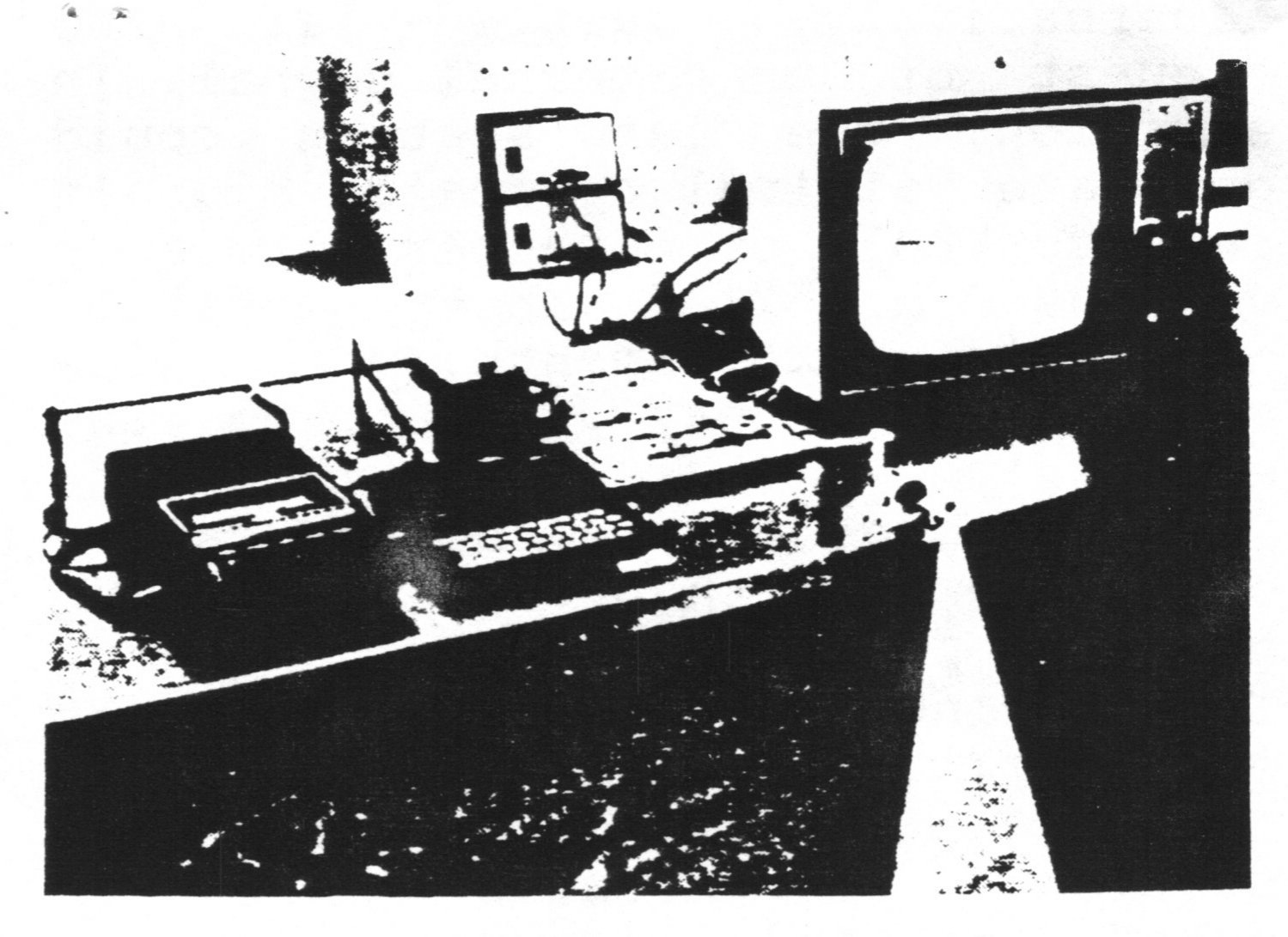
The prototype interfacing board (see photo) measures 7-1/2 by 5-1/2 inches. It should be possible to reduce the size to about 4 by 5 inches. Consequently, not only will the cost be low, but the size will be such as to take up very little space at the lab station. The TV monitor will be the biggest part of the system.
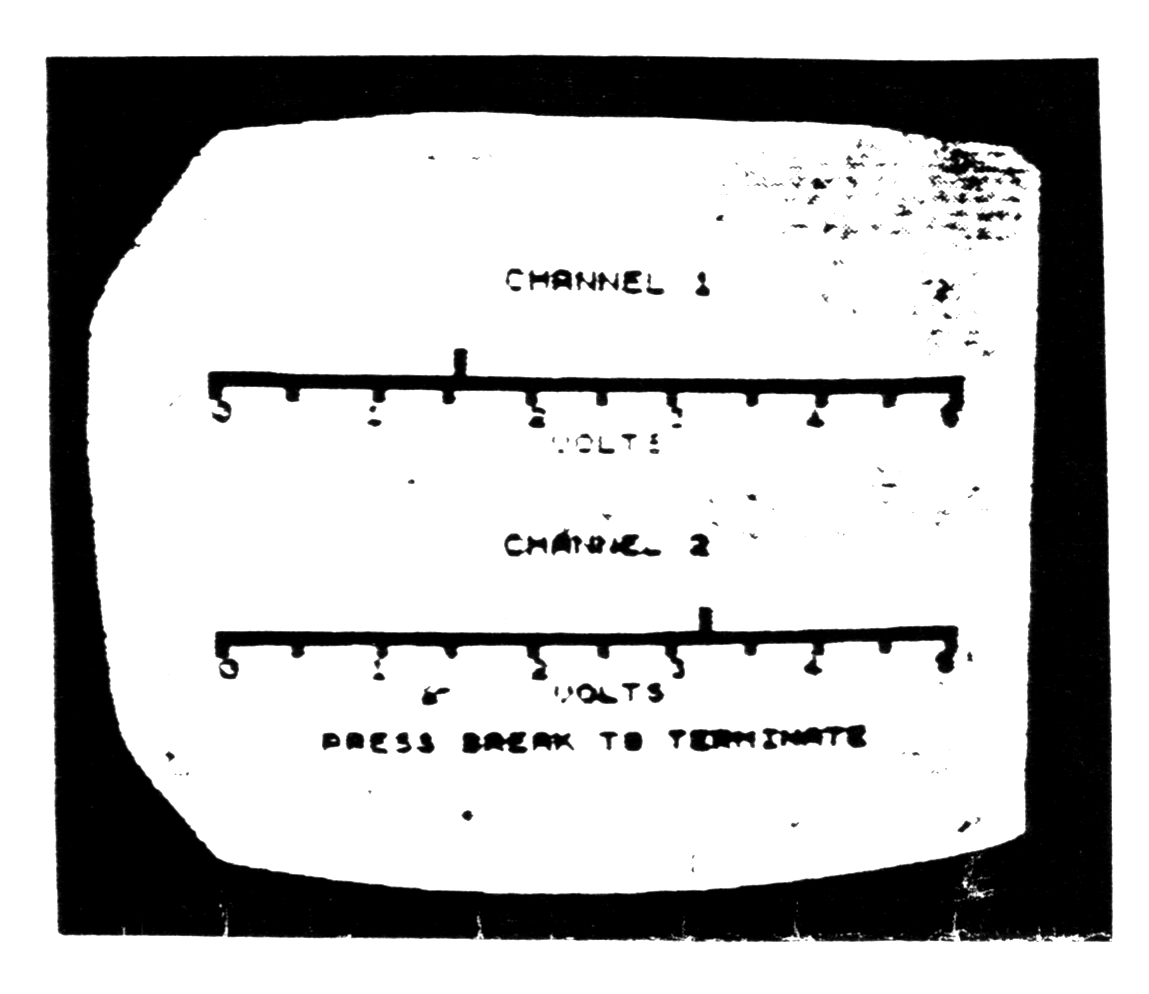
Preliminary software includes four programs. The first program displays the voltage levels on 2 of the 8 analog input channels on the interface board (see First Screen). A marker on the voltage line for each channel moves back and forth as the level is changed. A program such as this would be helpful during experiment set-up to determine if the voltage levels from the equipment are within the 0 to 5 volt range needed for the interface circuitry.
The second program samples the input voltages and plots the values on a time axis while the voltage is varying. For example, it generates a sine curve on the monitor as a potentiometer is rotated by a swinging pendulum. In its present form, the program plots the curve with 32 large squares. Double this resolution is possible. A curve made up of 64 data points, however, is still much too coarse for most experiments. Therefore, this program would be used in setting up an experiment, not in collecting the actual data.
A third program allows the collection of 500 data poiints at sampling time intervals of multiples of 100 microseconds. Once the data have been stored in the Timex/Sinclair, the communications portion of the program, together with a receive/send program in the Apple, can transfer the 500 data points to the Apple in one-half of one second. The transfer rate is 20,000 bits per second. The connection to the Apple is through its paddle port.
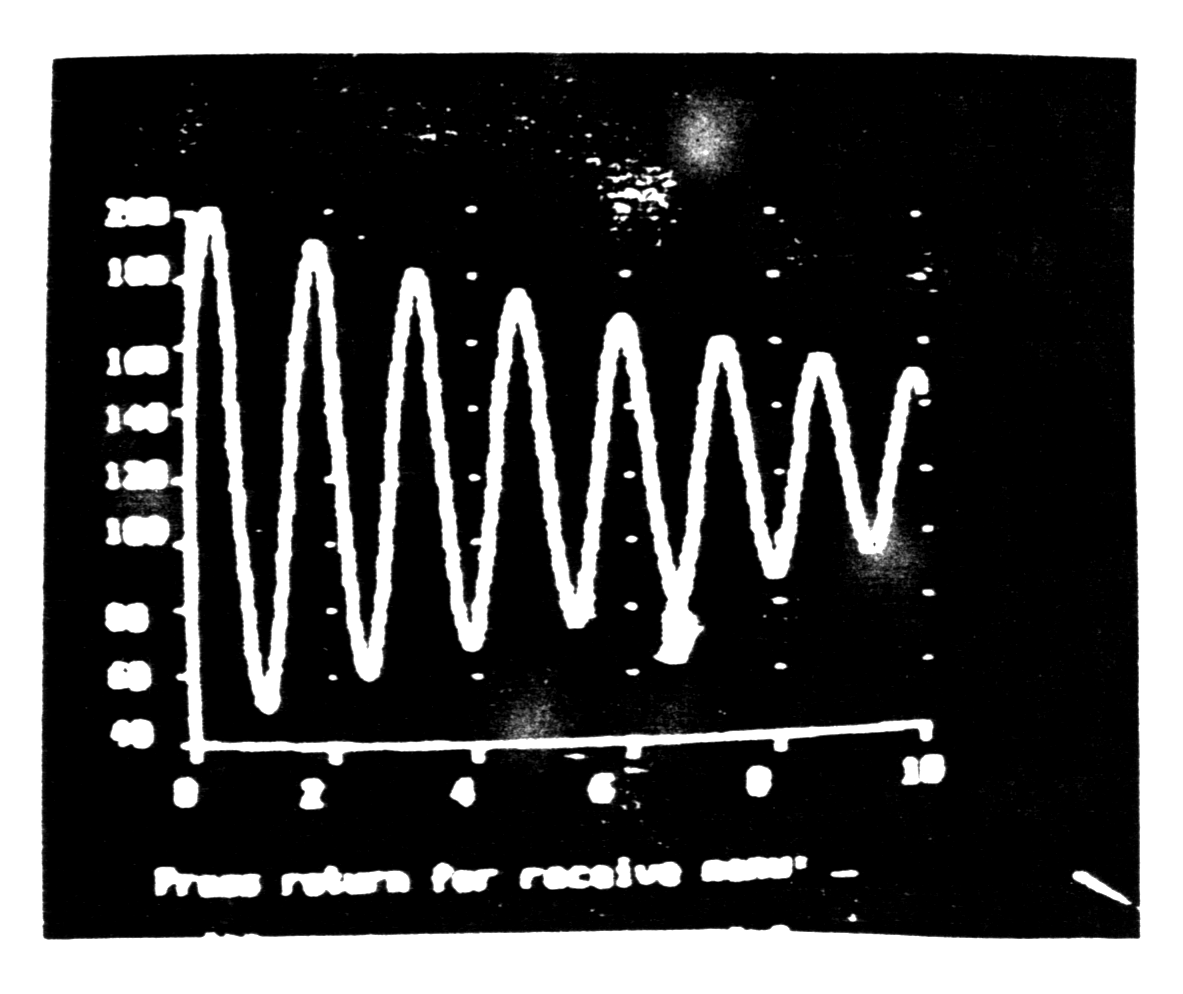
Consequently, the transfer of data can be made to an Apple II, an Apple II+, or an Apple IIe with no hardware modification. Once the data have been transferred to the Apple, a high resolution graphics program can be run to plot the data. The Second Screen shows the display which was obtained after a 10 second collection period (500 data points) for a swinging pendulum.
A fourth program has been written which allows the Timex/Sinclair to receive data from the Apple, again at 20,000 baud. In the planning stage is software which will load programs from the Apple into the Timex/Sinclair. With this capability, a cassette tape recorder will not be needed at each station.
When all is completed, the system —with up to 16 lab stations networked to the Apple—will be controlled by the Apple. Each Timex/Sinclair will have the capability to request programs from the Apple. The programs will include those for specific experiments (e.g., the swinging pendulum) as well as general-use programs.
With an almost unlimited demand perceivable for low-cost lab station networks around the country, the future for Timex/Sinclair in the field of lab automation seems promising, indeed!
(Epilogue: Author Larry Becker was reached this month at Hiram College, the same place he was when this article was published 10 years ago.
He remembers the T/S lab automation project with fondness. It only sputtered when Timex abandoned its computer product and the certainty of replacements became questionable.
Larry went on to develop popular college courses about contemporary microprocesors, mainly the 8088, Z-80, and the 6800.
As a result of presentations about his lab automation work, he became—during the school year—a consultant to a small New England computer firm. He also has worked then and now with the same firm during the collegiate summer break.
He still welcomes comments and suggestions about this special undertaking, and is reachable via:
Larry Becker
Department of Physics
P.O. Box 1778
Hiram College
Hiram, Ohio 44234
(216) 569-5248