re:Update
[address omitted]
This letter and its information is “inspired’ by a comment in your “Left Handed Ways of Working a Printer”, page 20 of the October 1989 issue of Update Magazine.
My computer set-up consists of two computers and three printers. Their printers are tied together WITHOUT expensive or manually switched “A/B” switches, yet the correct printer functions every time.
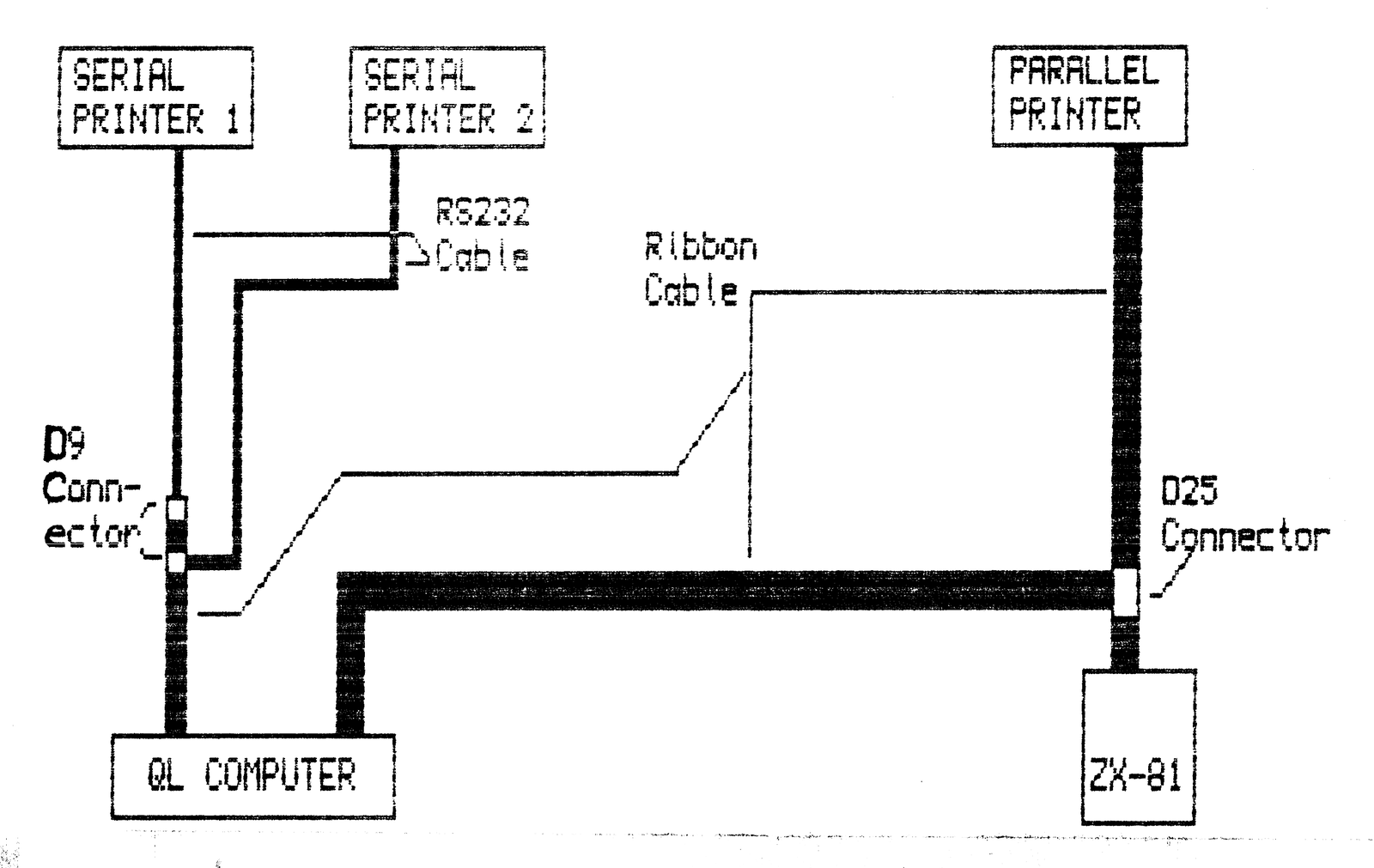
The actual arrangement of these devices is shown in the enclosed sketch.
Specifically, two serial printers are both connected to my QL’s Serial 1 [SER1] port. The two printers are electrically wired in parallel, the printer turned “on” is the one that prints.
This simple scheme works because all the electrical signals from an “off” printer are electrically “high” or in plain jargon, just not there. When a printer is turned “on” and “ready” it then sends an electrically “low” signal to the computer, allowing the computer to transfer data to the printer. Turning the printer “off”, or “off-line”, or “out of paper” transfers this signal from electrically “low” to “high”, stopping the computer’s data transfer to the printer. Summing up this arrengement, the QL will send printer data through SER1 to the printer turned “on”; all with out an expensive switch or the need to manually select the correct printer.
I also have one parallel printer that is similarly wired. This printer is wired electrically in parallel with my QL’s special parallel port and to my second computer’s parallel port. The second computer is my trusty and well equipted ZX-81. The ZX-81’s parallel port is a Memotech CIF. I only use and turn “on” one computer at a time, the QL or ZX. The computer “on” then prints to the common parallel printer. Operation is electrically similar to my serial printers. The Parallel interface from the “off” computer is electrically “high” and therefore funtionally non-existant.
The advantages of this simpler approach is the elimination of expensive “A/B” switches plus the need to consciously select the correct switch setting.
Regards,
Mort Binstock