
TRY THIS TRY THIS TRY THIS
Syntax commissioned a custom program, written by David Ornstein, to convert your existing programs for the 2068 or 48K Spectrums.
This program translates input bytes from ZX/TS tapes to an equal number of output bytes in your 2068 that you must edit, and then save. Codes & program control structures differ in the two designs, making functionally identical programs use different numbers of bytes.
Create the program in two parts–the translation table shown here and the executable portion.
44000         32     130     129     131     136
44005        138     137     139     143     143
44010        143      34      96      36      58
44015         63      40      41      62      60
44020         61      43      45      42      47
44025         59      44      46      48      49
44030         50      51      52      53      54
44035         55      56      57      65      66
44040         67      68      69      70      71
44045         72      73      74      75      76
44050         77      78      79      80      81
44055         82      83      84      85      86
44060         87      88      89      90     165
44065        166     167      32      32      32
44070         32      32      32      32      32
44075         32      32      32      32      32
44080         32      32      32      32      32
44085         32      32      32      32      32
44090         32      32      32      32      32
44095         32      32      32      32      32
44100         32      32      32      32      32
44105         32      32      32      32      32
44110         32      32      32      32      32
44115         32      32      32      13      32
44120         32      32      32      32      32
44125         32      14      32     143     141
44130        142     140     135     133     134
44135   13[illegible]     143     143     143      34
44140         96      36      58      63      40
44145         41      62      60      61      43
44150         45      42      47      59      44
44155         46      48      49      50      51
44160         52      53      54      55      56
44165         57      65      66      67      68
44170         69      70      71      72      73
44175         74      75      76      77      78
44180         79      80      81      82      83
44185         84      85      86      87      88
44190         89      90      32     172     173
44195         32     175     176     177     178
44200        179     180     181     182     183
44205        184     185     186     187     188
44210        189     190     192     193     194
44215        195      94     197     198     199
44220        200     201     203     204     205
44225        224     225     226      32      32
44230        230      32     232     233     234
44235        235     236     237     238     239
44240        240     241     242     243     244
44245        245     246     247     248     249
44250        250     251      32     253     254
44255        255
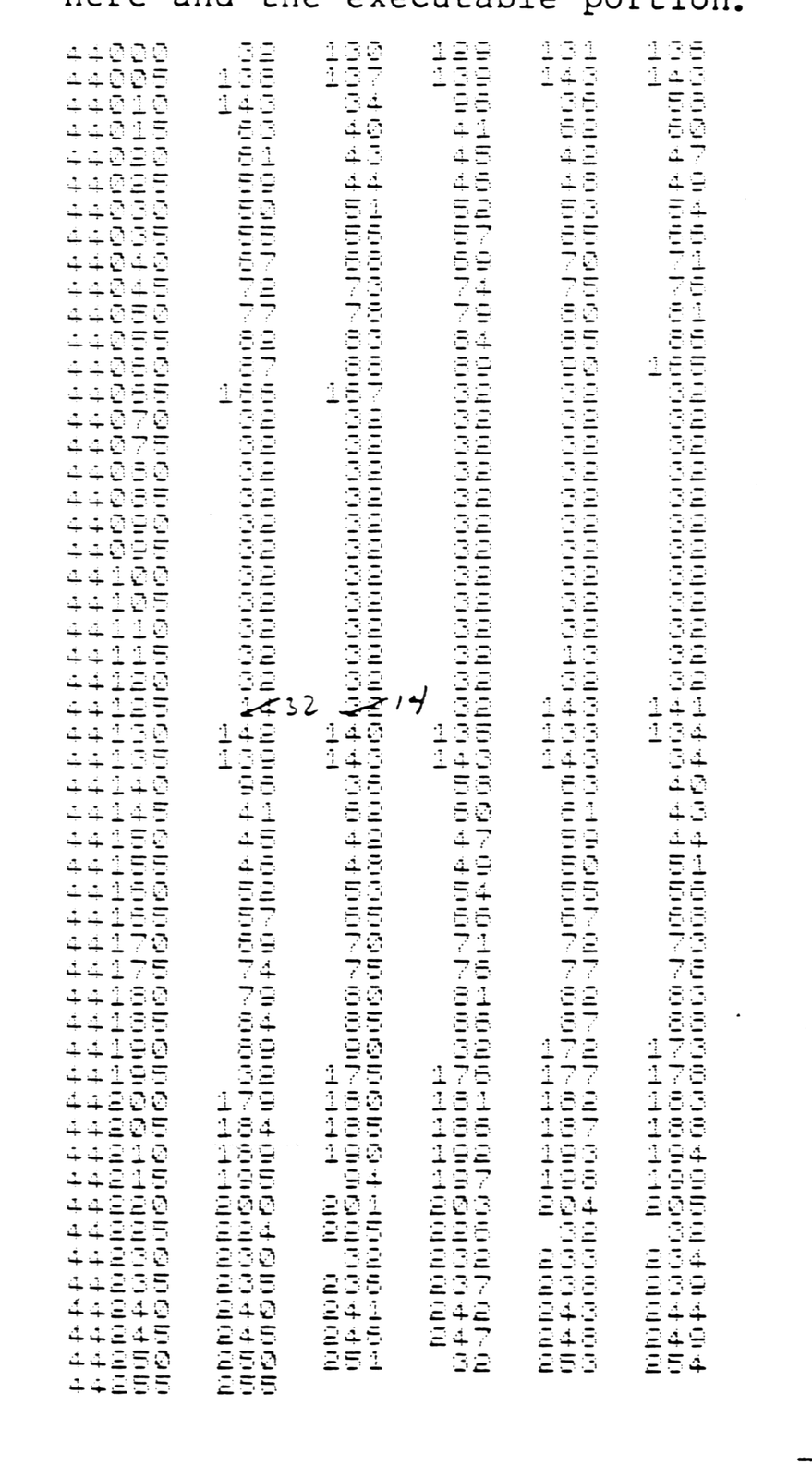
Direct tables, such as this, consist of an address, derived from the input code, containing an entry that equals a desired output code. Our table address consists of the CODE of the ZX/TS character +44000. Entries consist of 2068 codes to produce the character, command, or function. If no one corresponding code exists, we pick a substitute to hold the space. Then we edit the translated program as needed.
Use the table shown to produce the translator as Syntax tested it. We suggest you fill the table area with code 127 as you begin. That way, listing the table produces (C) symbols if you miss any entries.
You can modify the translation table to substitute any byte. Add 44000 to the ZX/TS character code, then POKE that address in your 2068 with the code you want the program to contain. Codes below 32 trigger errors in the display.
For example, say you want SLOW changed to REM. You take 228, the ZX/TS code for SLOW, add 44000, and POKE 44228,234–the 2068 REM code.
You can enter the executable code in whatever form you find convenient–we’ve provided both hex and decimal listings–but only the assembler listing is annotated.
Save the 2068 program using SAVE”FIRSTLOADR”CODE 44000,1250. Make several copies & VERIFY each.
To use the tape, CLEAR 43999, then LOAD”FIRSTLOADR”CODE (enter). When the 2068 displays 0 OK, 0:1 Position your ZX/TS tape in the 5-second quiet spot. Activate the loader by typing RAND USR 45000, and observe the red and black stripes in the border area. Then start the ZX/TS tape and observe the stripes again as they change width, indicating ones and zeros in the incoming data.
You will need a lower volume setting than if you were loading to a ZX/TS from the same recorder. You may find a Winky board eases loading. In some cases a 0.2 uF capacitor in series with the center conductor of the ear cord and a 1k resistor shunting the 2068 ear jack permits a wider range of volume settings for the ZX/TS tapes.
When the converter finds the end of the VARS area on the tape it switches from load to convert. At completion, your 2068 will display 0 OK, 0:1. LIST your proram and look for junk, If your translation looks OK, save it to a 2068 tape before you proceed. If the screen fills with garbage, or you get no listing, or LOADing of the ZX/TS tape stops early, type NEW, then try a different volume setting.
Edit the 2068 version to account for differences in comments and codes. Of course you can also add color functions to the 2068 program thus created.
Not all keywords translate sensibly–check your output list for the following:
Keyword   Action
CHR$      Change char code
CODE      Change compared value
FAST      Delete SpacE
PAUSE 0   Delete or use PAUSE 1
PEEK      Change address
PLOT      Reprogram
POKE      Change address, data
UNPLOT    Reprogram SpacE
USR       Change address
SCROLL    Delete SpacE or use PRINT
SLOW      Delete SpacE
Shift Q   Change SpacE to """
Also, the program removes all ZX/TS inverse characters, substituting normal characters, and translates the half-tone character graphics to solid blacks of the same shape.
After editing, save the latest updated and enhanced program for use with the 2068.
By modifying the translation table, you can substitute user-defined graphics as you convert.
You can purchase this program on tape for $19.95 ppd from E-Z Key, Suite 75-STX 711 Southern Artery, Quincy, MA 02169. Call 617/773-1187 to use VISA or MC.
This table shows addresses to POKE, in steps of five, with the values reading left-to-right for the 5 successive locations. POKE them manually or write a loop to advance the address automatically. These decimal codes correspond to the hexadecimal assembly listing on the following pages.
45000        205      60     176     205     222
45005        175       6       7      54     118
45010         35      16     251     205      89
45015        176     205     142     176     201
45020        207       3      33       9     192
45025         17      12       0      25      54
45030        254     167     237      82     205
45035        251     175     113     124     254
45040          0      40     233     205      75
45045        176     205      46     176      24
45050        239      14       1       6       0
45055        205      68     176      62     127
45060        219     254      31      48      49
45065         23      23      23      56       2
45070         24     239     213      30     148
45075          6      26      29     219     254
45080         23      23     203     123     123
45085         56     244      16     244     209
45090         32       4     254      86      48
45095        213      63     203      17      48
45100        208     201      35     235      42
45105         20     192      55     237      82
45110        235     208     193     201     207
45115         12     205     251     175     203
45120        121      40     249     201     120
45125        238       2     211     254      71
45130        201      17      21     192     122
45135        188     192     123     189     192
45140        126     198     128     119     201
45145         33     125     192     126     254
45150        118     200     205     101     176
45155         24     247      17       4       0
45160         25      62     127     219     254
45165         31      48     202     126     254
45170        126      32       8      54      14
45175         17       6       0      25      24
45180        236     229      17     224     171
45185         38       0     111      25     126
45190        225     119      35     254      13
45195         32     220     201      17     125
45200        192     167     237      82      68
45205         77     197      42      75      92
45210         43     237      91      83      92
45215        213     205     187      18     209
45220        237      83      83      92     193
45225         35      35     235      33     125
45230        192     237     176     201
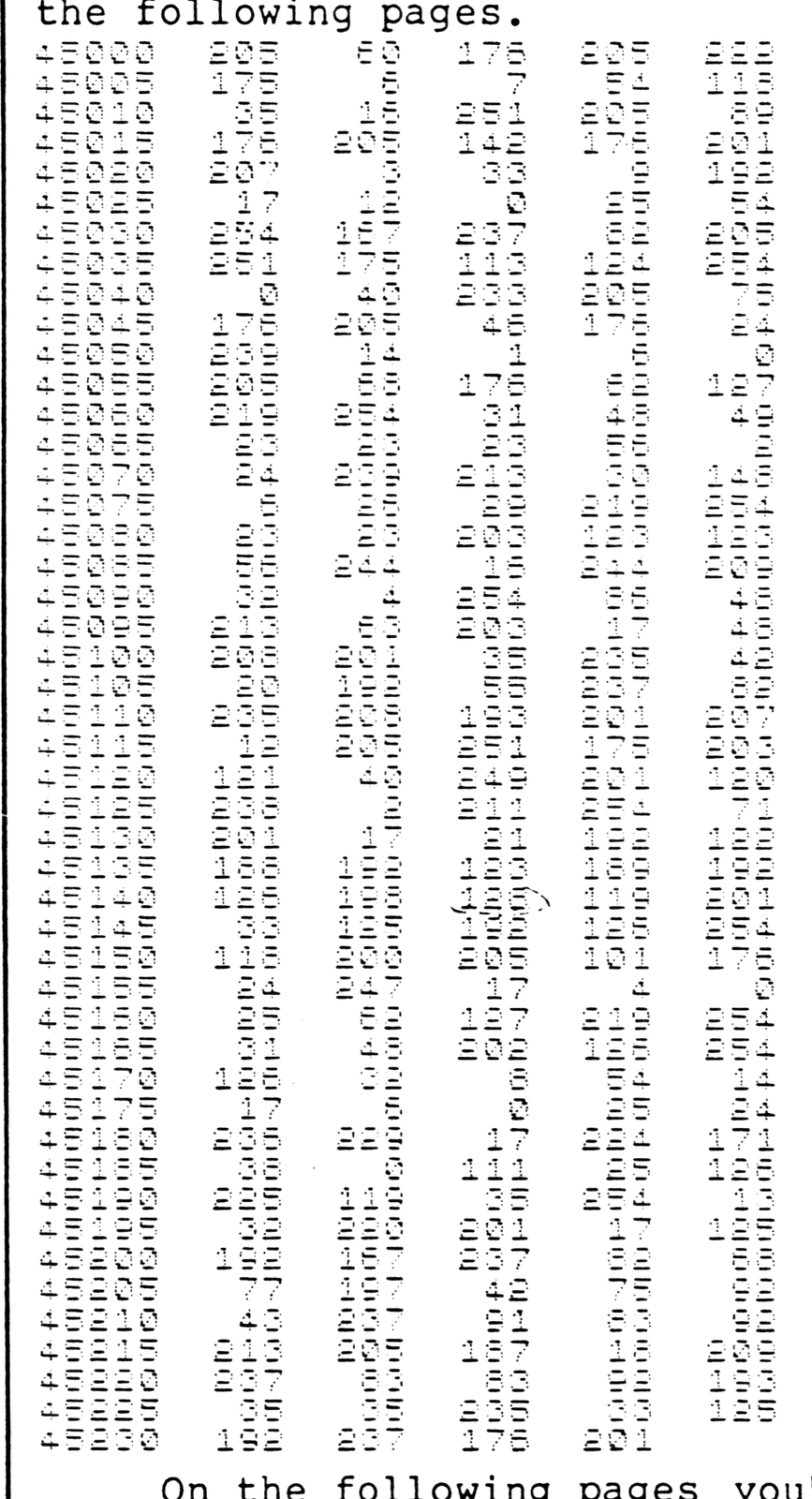
On the following pages you’ll find FIRSTLOADER code, assembled to location 45000. This excludes the translation table. Read columns as follows: hex address, hex code for instruction, assembler line number (ignore it), assembler label (for human use), then a Z80 instruction mnemonic or assembler pseudo-operator, operand mnemonics, and a semicolon followed by comments.
AFC8             00100            ORG     45000
AFC8 CD3CB0      00110            CALL    FNAME
AFCB CDDEAF      00120            CALL    LOADER
AFCE 0607        00130            LD      B,7
AFD0 3676        00140 INCASE     LD      (HL),118; ZX/TS NL
AFD2 23          00150            INC     HL
AFD3 10FB        00160            DJNZ    INCASE
AFD5 CD59B0      00170            CALL    XLATE
AFD8 CD8EB0      00180            CALL    MAKPRG
AFDB C9          00190            RET
AFDC CF          00200 ERR3       RST     8
AFDD 03          00210            DEFB 3
C014             00220 E1LINE     EQU     49172; ZX/TS E-LINE + 32K
C015             00230 E2LINE     EQU     49173
AFDE 2109C0      00240 LOADER     LD      HL,49161; ZX/TS VERSN + 32K
AFE1 110C00      00250            LD      DE,12
AFE4 19          00260            ADD     HL,DE   ; SKIP 12 BYTES HL PT 49173
AFE5 36FE        00270            LD      (HL),00FEH; LOAD AT LEAST 256 BYTES
AFE7 A7          00280            AND     A
AFE8 ED52        00290            SBC     HL,DE
AFEA CDFBAF      00300 LL36       CALL    INBYTE  ; GET BYTE IN C
AFED 71          00310            LD      (HL),C  ; STORE THE ZX/TS BYTE
AFEE 7C          00320            LD      A,H
AFEF FE00        00330            CP      0
AFF1 28E9        00340            JR      Z,ERR3
AFF3 CD4BB0      00350            CALL    EFIX    ; IF HL=E2LINE ADD 128 TO HI
AFF6 CD2EB0      00360            CALL    ENDBYT  ; BYTE (IND HL).  LAST BYTE?
AFF9 18EF        00370            JR      LL36
AFFB 0E01        00380 INBYTE     LD      C,1
AFFD 0600        00390 LL3        LD      B,0
AFFF CD44B0      00400 LL32       CALL    BORDER  ; FLIP COLOR
B002 3E7F        00410            LD      A,007FH
B004 DBFE        00420            IN      A,(00FEH)
B006 1F          00430            RRA
B007 3031        00440            JR      NC,LL7  ; IF BREAK IS PRESSED
B009 17          00450            RLA
B00A 17          00460            RLA
B00B 17          00470            RLA
B00C 3802        00480            JR      C,LL38  ; IF HAVE A SIGNAL
B00E 18EF        00490            JR      LL32
B010 D5          00500 LL38       PUSH    DE
B011 1E94        00510            LD      E,148
B013 061A        00520 LL4        LD      B,26
B015 1D          00530 LL5        DEC     E
B016 DBFE        00540            IN      A,(00FEH)
B018 17          00550            RLA
B019 17          00560            RLA
B01A CB7B        00570            BIT     7,E
B01C 7B          00580            LD      A,E
B01D 38F4        00590            JR      C,LL4
B01F 10F4        00600            DJNZ    LL5
B021 D1          00610            POP     DE
B022 2004        00620            JR      NZ,LL6
B024 FE56        00630            CP      86
B026 30D5        00640            JR      NC,LL3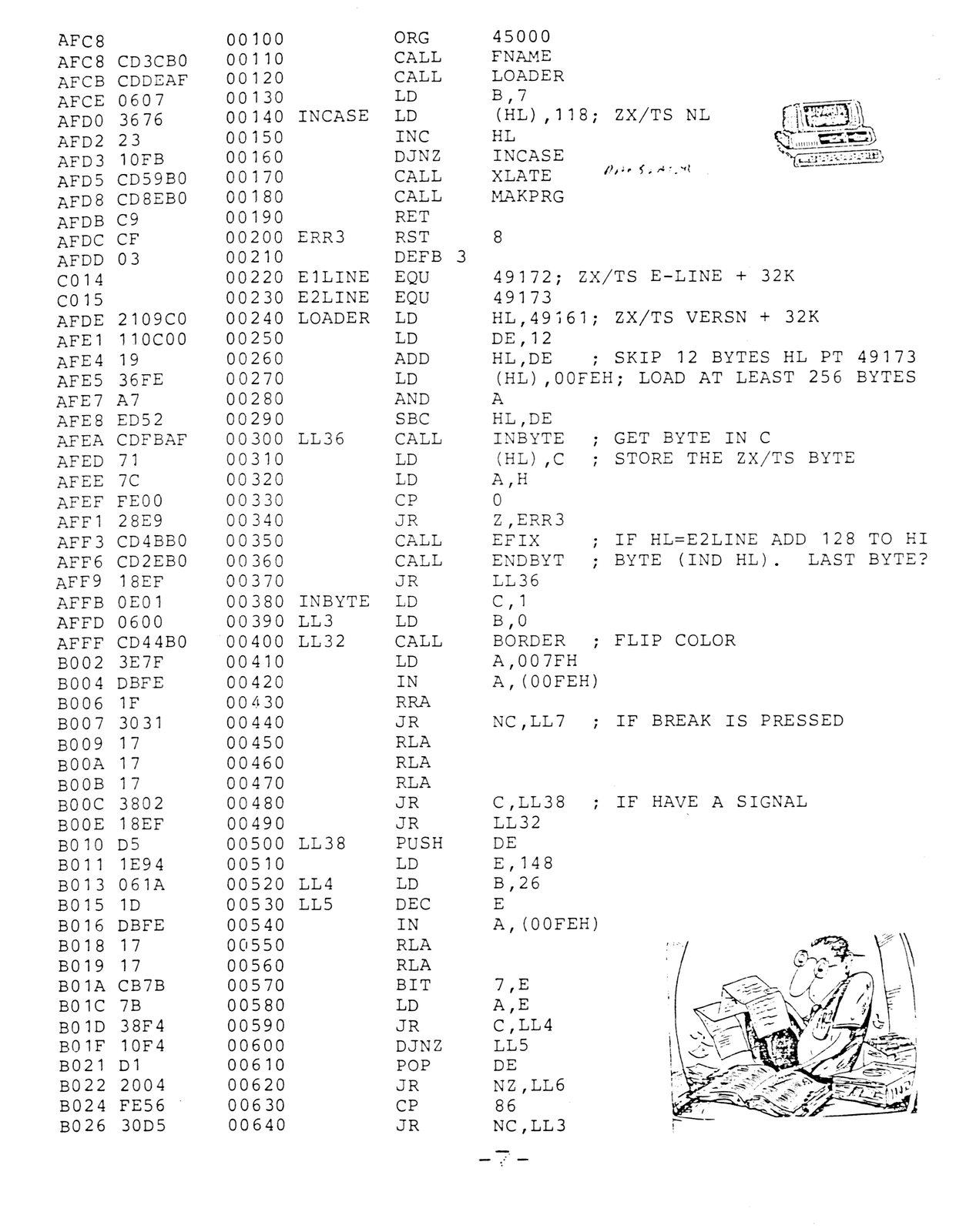
B028 3F          00650 LL6        CCF
B029 CB11        00660            RL      C
B02B 30D0        00670            JR      NC,LL3
B02D C9          00680            RET
B02E 23          00690 ENDBYT     INC     HL      ; WAS THAT THE LAST BYTE?
B02F EB          00700            EX      DE,HL
B030 2A14C0      00710            LD      HL,(E1LINE); IS HL PAST IND E1LINE?
B033 37          00720            SCF
B034 ED52        00730            SBC     HL,DE
B036 EB          00740            EX      DE,HL
B037 D0          00750            RET     NC
B038 C1          00760            POP     BC      ; GO BACK TO MAIN ROUTINE
B039 C9          00770            RET
B03A CF          00780 LL7        RST     8
B03B 0C          00790            DEFB 12
B03C CDFBAF      00800 FNAME      CALL    INBYTE  ; LOOK FOR 1ST INVERSE CHAR
B03F CB79        00810            BIT     7,C
B041 28F9        00820            JR      Z,FNAME; KEEP LOOKING
B043 C9          00830            RET             ; NOW START LOADING ZX CODE
B044 78          00840 BORDER     LD      A,B     ; FLIP BORDER COLOR 2 OR 0
B045 EE02        00850            XOR     2
B047 D3FE        00860            OUT     (00FEH),A
B049 47          00870            LD      B,A
B04A C9          00880            RET
B04B 1115C0      00890 EFIX       LD      DE,E2LINE; DID I JUST LOAD TO E2LINE
B04E 7A          00900            LD      A,D
B04F BC          00910            CP      H       ; COMPARE HI BYTE
B050 C0          00920            RET     NZ
B051 7B          00930            LD      A,E
B052 BD          00940            CP      L       ; COMPARE LO BYTE
B053 C0          00950            RET     NZ
B054 7E          00960            LD      A,(HL)
B055 C680        00970            ADD     A,128   ; ADD 32K
B057 77          00980            LD      (HL),A
B058 C9          00990            RET
B059 217DC0      01000 XLATE      LD      HL,49277; 1ST BYTE OF 1ST LINE #
B05C 7E          01010 LXL1       LD      A,(HL)  ;   AT 16509+32K
B05D FE76        01020            CP      118     ; IS IT 1ST NL IN ZX D-FILE
B05F C8          01030            RET     Z       ; IF SO, YOU'RE DONE
B060 CD65B0      01040            CALL    LINE
B063 18F7        01050            JR      LXL1
B065 110400      01060 LINE       LD      DE,4    ; SKIP LINE # & LENGTH
B068 19          01070            ADD     HL,DE
B069 3E7F        01080 LLIN1      LD      A,007FH ; TEST BREAK ON 2068
B06B DBFE        01090            IN      A,(00FEH); GET CHAR IN ACCUM
B06D 1F          01100            RRA
B06E 30CA        01110            JR      NC,LL7  ; EXIT IF BREAK PRESSED
B070 7E          01120            LD      A,(HL)  ; GET BYTE
B071 FE7E        01130            CP      126     ; CHECK FOR ZX/TS SLUG
B073 2008        01140            JR      NZ,LLIN2; GET CODE FROM TABLE
B075 360E        01150            LD      (HL),14 ; SUBST 2068 SLUG
B077 110600      01160            LD      DE,6    ; SKIP SLUG + 5 BYTES
B07A 19          01170            ADD     HL,DE
B07B 18EC        01180            JR      LLIN1   ; DO IT AGAIN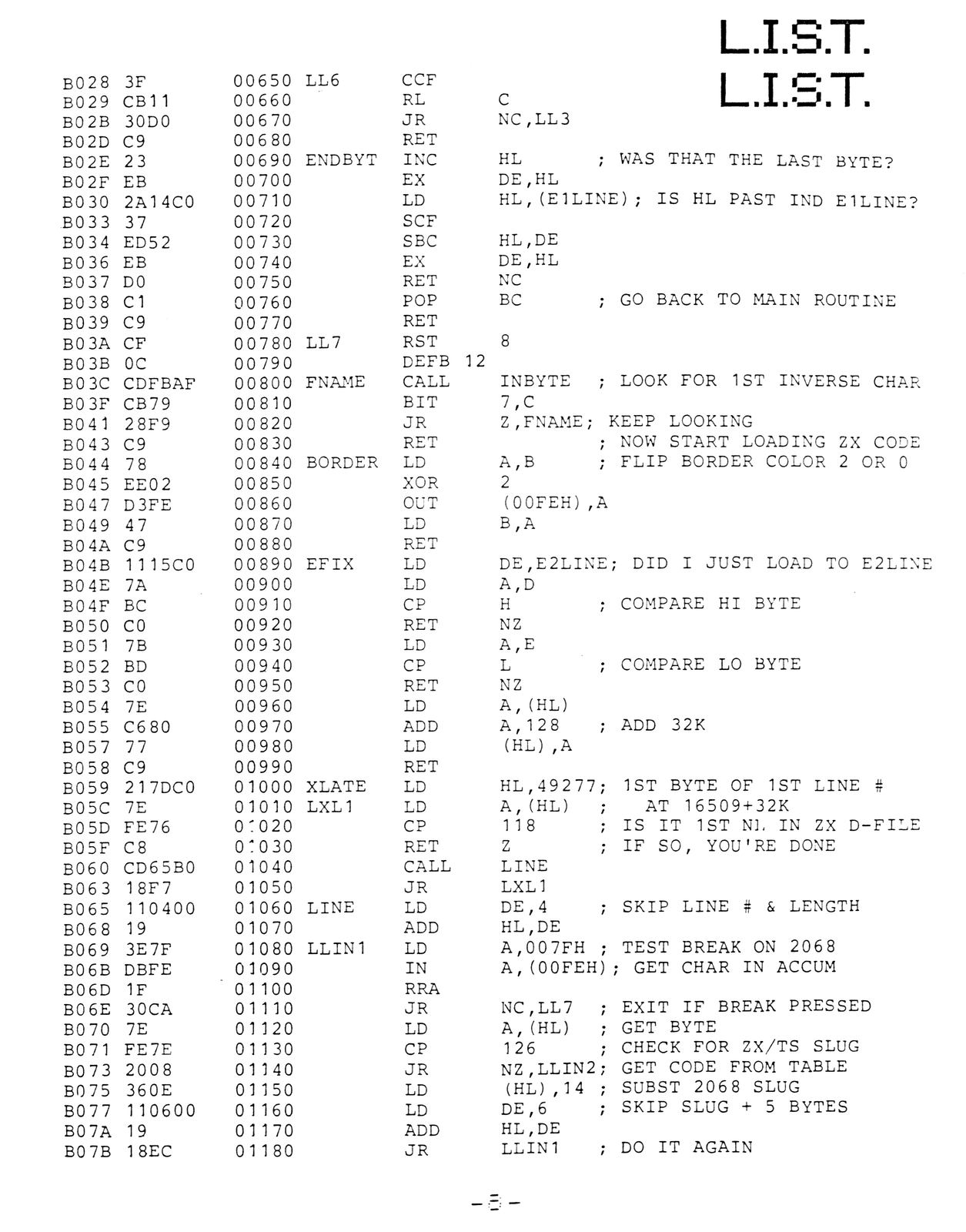
B07D E5          01190 LLIN2      PUSH    HL      ; STORE THE BYTE ADDRESS
B07E 11E0AB      01200            LD      DE,44000; TABLE START ADDRESS
B081 2600        01210            LD      H,0     ; PUT ZX/TS CHAR CODE IN HL
B083 6F          01220            LD      L,A
B084 19          01230            ADD     HL,DE   ; ADDRESS OF BYTE IN TABLE
B085 7E          01240            LD      A,(HL)  ; GET BYTE FROM TABLE TO A
B086 E1          01250            POP     HL      ; RECALL BYTE ADDRESS
B087 77          01260            LD      (HL),A  ; PUT NEW CODE IN OLD ADDRESS
B088 23          01270            INC     HL
B089 FE0D        01280            CP      13      ; CHECK FOR 2068 NL
B08B 20DC        01290            JR      NZ,LLIN1; NO, DO IT AGAIN
B08D C9          01300            RET             ; FINISHED THAT LINE
B08E 117DC0      01310 MAKPRG     LD      DE,49277; APPEND PROG TO 2068 CONTENT
B091 A7          01320            AND     A
B092 ED52        01330            SBC     HL,DE   ; HL PT 1ST BYTE OF D-FILE
B094 44          01340            LD      B,H     ; BC = NO. BYTES IN PROGRAM
B095 4D          01350            LD      C,L
B096 C5          01360            PUSH    BC      ; SAVE SIZE OF PROG
B097 2A4B5C      01370            LD      HL,(23627); ADDRESS OF 2068 VARS
B09A 2B          01380            DEC     HL
B09B ED5B535C    01390            LD      DE,(23635); ADDR OF 2068 BASIC PROG
B09F D5          01400            PUSH    DE      ; SAVE PROG SYSVAR
B0A0 CDBB12      01410            CALL    4795    ; CALL ROM INSERT-USE 5717 ON
B0A3 D1          01420            POP     DE      ; SPECT-RESTORE PROG SYSVAR
B0A4 ED53535C    01430            LD      (23635),DE
B0A8 C1          01440            POP     BC      ; BYTE COUNT OF PROG
B0A9 23          01450            INC     HL
B0AA 23          01460            INC     HL
B0AB EB          01470            EX      DE,HL   ; DE=DATA DESTINATION
B0AC 217DC0      01480            LD      HL,49277; START OF STUFF TO MOVE
B0AF EDB0        01490            LDIR            ; BLOCK MOVE
B0B1 C9          01500            RET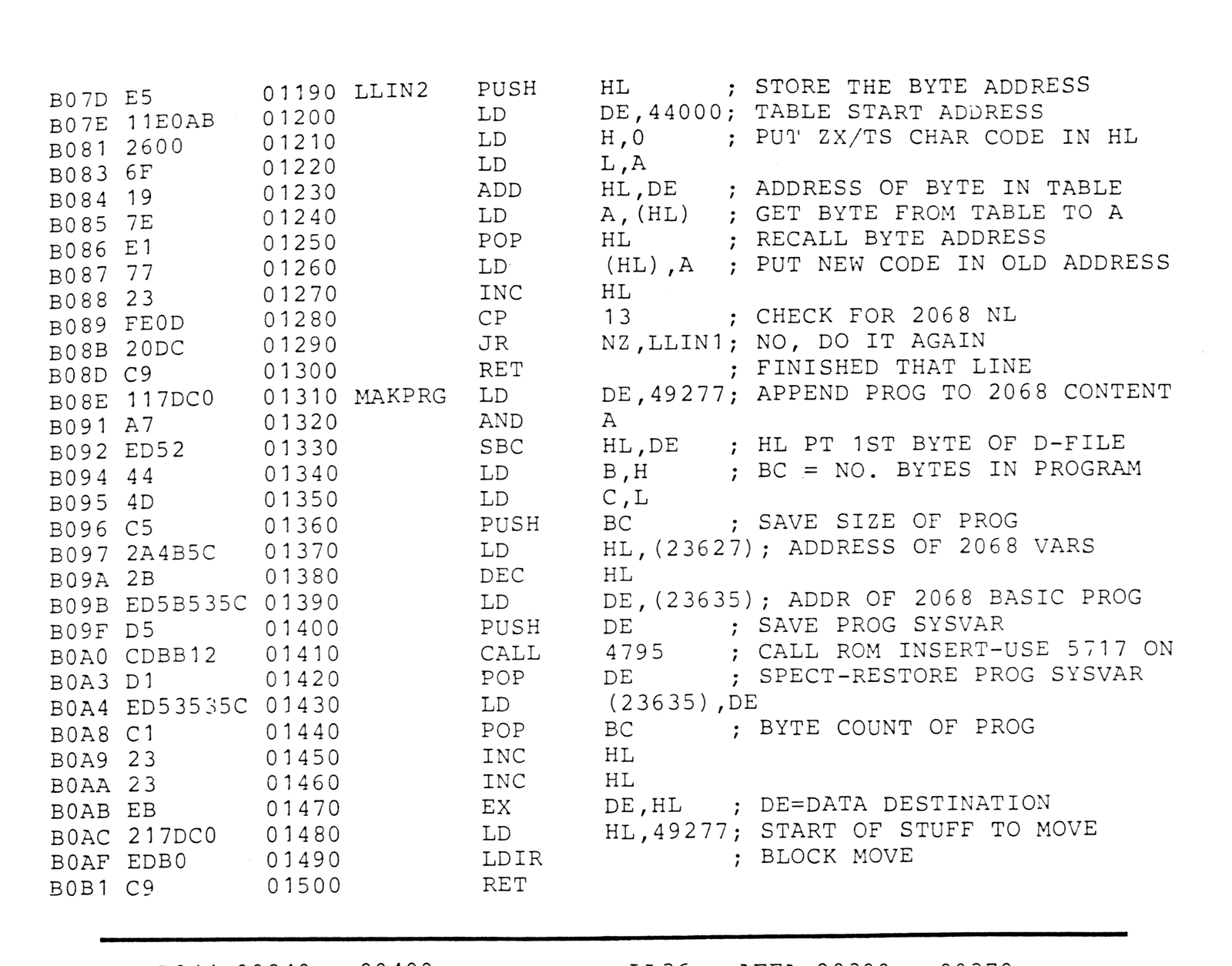
BORDER B044 00840   00400         LL36   AFEA 00300   00370
E1LINE C014 00220   00710         LL38   B010 00500   00480
E2LINE C015 00230   00890         LL4    B013 00520   00590
EFIX   B04B 00890   00350         LL5    B015 00530   00600
ENDBYT B02E 00690   00360         LL6    B028 00650   00620
ERR3   AFDC 00200   00340         LL7    B03A 00780   00440 01110
FNAME  B03C 00800   00110 00820   LLIN1  B069 01080   01180 01290
INBYTE AFFB 00380   00300 00800   LLIN2  B07D 01190   01140
INCASE AFD0 00140   00160         LOADER AFDE 00240   00120
LINE   B065 01060   01040         LXL1   B05C 01010   01050
LL3    AFFD 00390   00640 00670   MAKPRG B08E 01310   00180
LL32   AFFF 00400   00490         XLATE  B059 01000   00170
Only one change will make this program work with a 48K Spectrum as well. At B0A0H (45216 decimal), we call a ROM routine located at 4795 in the TS2068 and at 5717 in the Spectrum. These routines create an empty space, but you must fill it.
Most of this code is self-contained. Only the routine XLATE, located at 45145, passes a value to the code for MAKPRG. If you modify code, restore the value held in HL on return from address 45151 prior to calling MAKPRG.
Note: Type-in program listings on this website use ZMAKEBAS notation for graphics characters.