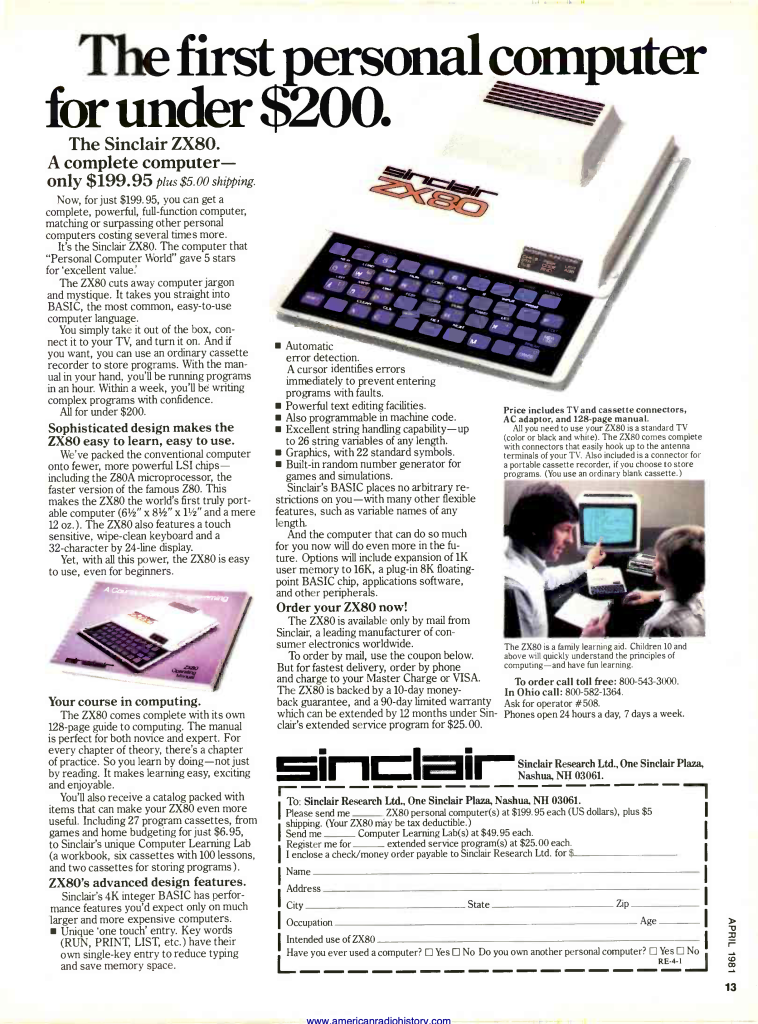
The ZX80 was Sinclair’s first computer sold in the United States. Sinclair launched it in Britain in February 1980, showed it at the Summer Consumer Electronics Show in Chicago in June, and, as Nigel Searle put it, introduced it in the U.S. in August 1980. BYTE noted that it “did not become available until the fall.” It was notable for its size, weight and price: 6½″ × 8½″ × 1½″, twelve ounces, and $199.95 assembled. While it waited, BYTE said, “the price has dropped from the expected $245 to just under $200.” It was the least expensive personal computer available, although not the smallest: BYTE pointed to the new pocket computers.
The Wall Street Journal said it was “called ZX80 after the Japanese microprocessor it utilizes,” the NEC copy of the Z80. David Tebbutt was less sure: “No reason really except that it’s based on an NEC copy of the Z80.” Sinclair kept the ZX prefix for its later computers up to the QL.
It had 1K of RAM (BYTE found “a pair of 4 K-bit static memory devices”), a 4K ROM holding a limited version of BASIC, and an NEC 780C-1 processor, a copy of the Z80, running at 3.25 MHz. It connected to the owner’s TV for display and, like many home computers of the time, used cassette tape for storage.
The ZX80 was designed around readily available and inexpensive TTL integrated circuits (“chips”). BYTE counted “only twenty-two standard integrated circuits, including the voltage regulator.”
Sinclair cut costs by using an inexpensive case and a flat, membrane keyboard. The individual keys were etched on the circuit board and covered by a thin, conductive membrane printed with the key symbols.
BASIC
The majority of home computers available in 1980 contained a BASIC interpreter in ROM. In most of those computers, the BASIC ROM was at least 8K (8,192 bytes) in size and supported most of the features of Dartmouth BASIC they were based on.
An 8K BASIC interpreter was the base level against which other systems were measured. An “extended” BASIC might be in a larger, 16K ROM or load from disk, for example.
By contrast, the original ZX80 BASIC was contained in a 4K ROM. It was impossible to include the entire BASIC keyword and feature set and the ZX80 BASIC was a subset of the standard.
Sinclair saved ROM space by upending how BASIC programs were entered. Instead of typing out the full keyword, most Sinclair BASIC keywords were entered via a single keystroke (or with a shift key). Entering “PRINT”, for instance, required only a press of the O key.
Tebbutt counted 29 instructions that could be entered with a single keystroke; “only 8 need to be keyed in full.”
Space saving efforts resulted in other shortcomings in Sinclair BASIC, including:
- Lack of support for named files. Users merely “SAVEd” or “LOADed” the next program on the tape. File management was entirely up to the user.
- Some features in other BASICs, most notably READ, DATA and RESTORE, were missing from Sinclair BASIC.
- Numeric variables were limited to integer values from -32768 to 32767.
- Only 26 string variables (A$ to Z$) were available.
- Line numbers were limited to 1 to 9999.
- Statements were limited to one per line number.
On the other hand, Sinclair BASIC had dynamic syntax checking. The ZX80 would check the program line as the user entered it and it would not let users enter invalid program code.
Video Display

The ZX80 display was equally unconventional. Instead of a full-screen of code where any line could be edited at will, the ZX80 display was divided in to an upper area of 32 characters across by 22 lines down. A lower section, of two lines, was the “input area” where users enter program lines or responded to input prompts from the computer.
The ZX80 was limited to upper case letters and the organization of characters was not compatible with ASCII, the industry standard. Special block characters and their inverse (reverse video) allowed users to make relatively low resolution graphic displays.
Video signal generation was one of its most notable trade-offs. The Z80A ran at about 3.25 MHz, against “about 1.77 MHz for the TRS-80 Model I,” but it also generated the video signal. The picture disappeared whenever the processor was busy: as BYTE put it, “When the ZX80 is executing a program, the TV screen goes black.” Pressing a key made the screen flicker. Kilobaud’s reviewer turned this into a feature: “I watched for the flicker as an indication that my input was entered correctly.”
This made moving graphics difficult, since a program had to pause so the computer could show the display. Softsync’s Super ZX80 Invasion, released in early 1981, kept the display on screen, and its author would not say how.
The screen display was stored in the computer’s RAM, and only as much of it as was in use: the program and variables “grow” up into the screen buffer. As a program grew, less room was left for the screen, and the other way round. Sage Kring worked out that the system variables and a blank display left 959 bytes of the 1K for program lines, variables and the display itself.
Expansion
Other than the built-in cassette and video ports, the only means of expansion was a slot at the rear of the case, which exposed an edge connector on the motherboard. Sinclair’s first RAM packs held up to 3K in 1K steps. A 16K RAM pack followed; the FCC approved it for the US in mid-December 1980.
Sinclair announced an 8K ROM upgrade in the autumn of 1980, at $40 with “a keyboard template showing the 37 additional functions and a supplemental operating manual”. It arrived in the US in 1981 for $39.95, and it was popular with ZX80 owners.
Users opened their ZX80, pried the old ROM from its socket, inserted the new one and fitted the keyboard overlay. The new ROM could not give the ZX80 the ZX81’s SLOW mode, which needed hardware the ZX80 lacked; Synchro-Sette warned that “the converted ZX-80 is always in the FAST mode.” Add-on kits supplied the missing hardware, such as one sold in 1982 for $32.50.
Because tapes were not compatible between the two ROMs, some owners built circuits to switch between them. One wrote that he “could not load programs in integer (4K) BASIC” after upgrading; another design put both ROMs in one ZX80.
Hobbyists also attached full-size keyboards to their ZX80s, even moving the motherboard into a larger case. This made the machine easier to type on and gave the motherboard more ventilation.
Reception
BYTE noted that the ZX80 was “widely advertised as the first personal computer for under $200.”
The first mention of the ZX80 in the US was in the January 31, 1980 edition of the Wall Street Journal, which announced that the computer, at about $220, would “be marketed by the company’s Boston office in a few months.”
The Wall Street Journal noted the unique physical attributes of the computer, and that other personal computers “cost more than twice the Sinclair model.” It also reported: “About 20,000 to 30,000 personal computers are sold monthly” in the United States.
Sinclair formally introduced the ZX80 at the 1980 Summer Consumer Electronics Show in Chicago. Creative Computing and Infoworld were among several specialty magazines to highlight the computer in their coverage of the event.
By November 1980, Syntax ZX80, a newsletter devoted to the ZX80, had launched, and Searle endorsed it as the newsletter for the ZX80. SYNC magazine, also devoted to the ZX80, appeared with a January/February 1981 issue and had passed 8,000 subscribers by the autumn. Syntax dropped “ZX80” from its name in August 1982.
Reviews of the computer appeared in popular computing magazines as early as December 1980.
Kilobaud Microcomputing (December 1980) praised the design and packaging, and said that the screen flickering during input or output was annoying but was useful as an indicator of the computer functioning correctly. It praised the documentation as excellent for novices, and noted that purchasing the computer was cheaper than taking a college class on BASIC. The magazine concluded the “ZX-80 is a real computer and an excellent value,” but only for beginners who could learn from the documentation or programmers experienced with writing Z-80 software.
BYTE (January 1981) called the ZX80 a “remarkable device.” It praised the real-time, interactive BASIC syntax checking, and reported that the computer performed better on benchmarks than some competitors, including the TRS-80 Model I. The screen blanking during program execution, small RAM size and inadequate built-in Sinclair BASIC, and the keyboard received criticism, and the review recommended against buying the kit version of the computer given the difficulty of assembly and because purchasers did not save money. BYTE concluded that “the ZX80 might be summarized as a high-performance, very low-cost, portable personal computer system … the ZX80 is a good starting point.”
Sales
Almost all ZX80s were sold by mail order: Sinclair did not have a distribution network in the United States. Potential owners read about the ZX80 in magazines and ordered it without having seen it in person.
At the time, it was not unusual for computer and electronics hobbyists to purchase products via mail order. Most cities did not have computer stores and those that did sold systems that cost thousands of dollars. Radio Shack stores brought their computers to many cities and smaller towns but even the least expensive TRS-80, the $400 Color Computer, cost about twice as much.
Advertisements for the ZX80 started to appear in popular computing magazines in the fall of 1980. On December 11, 1980, Nigel Searle of Sinclair told the Amateur Computer Group of New Jersey that worldwide sales were “in excess of 50,000 units.”
By March 1981, Infoworld called Sinclair “the third major competitor in the personal-computer industry.”
The New York Times reported that Sinclair was producing 10,000 ZX80s a month, third in volume behind Apple and Tandy (Radio Shack), and that more than 50,000 had been sold in the first nine months of the previous year, more than half of them abroad.
The Guardian reported that the ZX80 had sold 30,000 units in the US.
- October 1980: 8,000 shipped in eight months in the UK, according to Kilobaud; InfoWorld gave 17,000 sold in all.
- November 1980: “nearly 4000 units in the US now,” according to Syntax.
- 1981: Clive Sinclair told the Wall Street Journal he had “already sold 100,000” since the UK launch.
Kits, Clones and Service
In the US the ZX80 was sold mainly assembled. Tebbutt wrote that “the kit version is only available in the U.K.”, and BYTE warned kit buyers that “you will not save money by doing so.” Searle told of a kit buyer who called to ask, “What’s a soldering iron?”
Americans who wanted a kit could buy the MicroAce, which “bears a striking resemblance to the ZX-80” and cost $149 in kit form. Alfred Milgram of Melbourne House said its makers had “copied the ROM, byte for byte.”
Popular Electronics found that the grounding straps on the RF modulator could fail to make contact. Overheating was common enough for Syntax to run hints for owners whose ZX80s ran hot. Sinclair offered an extended service contract at $25 a year covering parts, labor and return shipping.
The End of the ZX80
The ZX81 reached the US on October 7, 1981. Searle later recalled that “in the States we’d been selling the ZX80 while the rest of the world had the ZX81.” Popular Science expected that “the earlier ZX80 will probably be phased out,” and noted a ZX81 retrofit kit for $45. Sinclair sold off the rest: used ZX80s for $49.95 in August 1981, most of them British kits “assembled incorrectly,” and by April 1982 it had “sold out their non-working ZX80 PCBs.”
References
- “U.K. Firm Bringing Out Small, Low-Priced Microcomputer.” The Wall Street Journal, January 31, 1980, sec. J.
- “World’s Lowest-Priced Computer.” Infoworld, March 2, 1981.
- Ahl, David. “Random Ramblings: The Consumer Electronics Show.” Creative Computing, September 1980.
- Ahl, David. “Random Ramblings: The British Scene.” Creative Computing, November 1980.
- Tebbutt, David. “Sinclair ZX80.” Creative Computing, December 1980.
- Thornburg, David, and Betty Burr. “Computers and Society.” Compute!, September/October 1980.
- Craig, John. “New Consumer Computers Premiere at CES.” Infoworld, August 4, 1980.
- McCallum, John. “The Sinclair Research ZX80.” BYTE, January 1981.
- Wszola, Stanley. “The Sinclair ZX-80 Microcomputer.” Kilobaud Microcomputing, December 1980.
- Warren, Carl. “Popular Electronics Tests: The Sinclair Research ZX80 Personal Computer.” Popular Electronics, August 1981.
- Searle, Nigel. “The Home Computer Market, the ZX80 and the Future.” SYNC, March/April 1981.
- Palmer, John. “Sinclair’s ZX80: Review of a Very, Very Small Computer.” Dr. Dobb’s Journal, February 1981.