
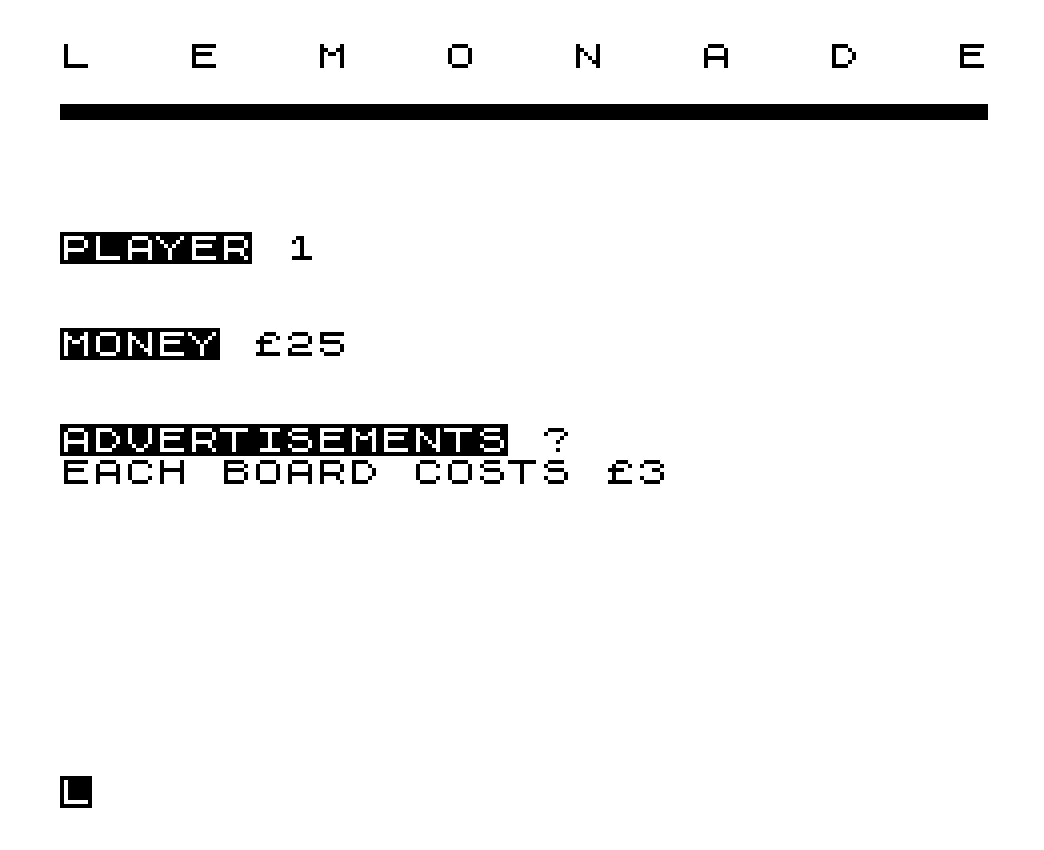
Lemonade is a multi-player business simulation game for two to four players, spanning up to 14 days of trading. Each day, players manage a lemonade stall at “Lemondsville,” purchasing advertising boards and bottles of lemonade, then setting a price per glass, with weather (sunny, rainy, or snowy) affecting visitor numbers and hence potential sales. Sales are computed using a demand formula influenced by price, visitor count, advertisement spend, and a random factor, with a market-sharing adjustment applied when total demand across players exceeds visitor numbers. End-of-game standings are displayed using CHR$(U+156) to print UDG characters as player tokens.
Program Structure
The program is organised into three broad sections:
- Initialisation (lines 278–531): Title display, optional instructions branch, player and day count input, and array allocation/reset.
- Main game loop (lines 532–1320): Outer loop over days (
E), inner loop over players (F) for purchasing decisions, followed by sales calculation and reporting loops. - End-of-game and utilities (lines 1329–9520): Final scoreboard, replay prompt, SAVE/RUN lines, instructions subroutine, and a stub subroutine at 9500.
Array Declarations
| Array | Size | Purpose |
|---|---|---|
M(P) | P | Each player’s money balance |
A(P) | P | Advertising boards purchased |
R(P) | P | Declared but never used |
L(P) | P | Price per glass in pence |
B(P) | P | Bottles purchased |
Q(P) | P | Glasses available (bottles × 10) |
I(P) | P | Declared but never used |
S(P) | P | Glasses sold this day (re-DIM’d each day at line 980) |
Notably, R(P) and I(P) are allocated but never written or read during play, wasting a small amount of memory.
Sales Demand Model
The core economic simulation at lines 1030–1085 works as follows:
- Base demand:
S(C) = (V*10) / L(C)— inversely proportional to price. - If price is between 31 and 50 pence, demand is replaced with a small random fraction of visitors, sharply reducing sales.
- If price exceeds 50 pence, demand is forced to zero.
- Advertising bonus:
Z = RND * A(C) * 5, thenS(C) += Z*2. - A 75% efficiency factor is applied:
S(C) = INT(S(C) * 0.75).
After individual demands are computed, lines 1130–1170 implement a market-sharing mechanism: if total demand across all players exceeds visitor count, the surplus (divided evenly) is subtracted from each player’s sales. This is a simple but effective way to model competition.
Sales are then capped at the player’s available glasses (Q(H)), clamped to zero if negative, and also capped at total visitors (V).
Weather System
Each day, W = INT(RND*4) selects a weather type. Values 0 and 3 both map to “SUNNY”, giving it a 50% probability, while “RAIN” and “SNOW” each have 25%. The base visitor count G is set to 175, 75, or 10 respectively. Actual visitors are V = INT(RND*50) + G, adding up to 49 random visitors on top.
Pricing and Cost Variables
Each day, advertising board cost (AP) and bottle cost (BP) are randomised:
AP = INT(RND*3)+1— £1, £2, or £3 per board.BP = INT((RND*4)+1)*0.5— £0.5, £1.0, £1.5, or £2.0 per bottle.
Each bottle yields 10 glasses. Money is deducted at input time (lines 680, 775) and earned at end-of-day based on INT(S(J)*L(J))/100 (converting pence to pounds). The profit display on line 1270 correctly subtracts bottle and advertising costs from revenue.
Notable Techniques and Idioms
- Busy-wait delays: Lines 540–541, 840–850, 950–960, 1280–1290 use empty
FOR/NEXTloops (up to 125 iterations) as timing delays — a standard Sinclair BASIC technique. - INKEY$ polling: Lines 290–320 and 1390–1420 use the poll-and-branch pattern for single-keypress input without pressing ENTER.
- Re-dimensioning inside a loop:
DIM S(P)at line 980 is called inside the day loop, which reinitialises the array to zero each day — a deliberate reset technique. - CHR$(U+156): Line 1345 uses
CHR$(U+156)to print UDG characters A–D as player identifiers on the scoreboard (UDG “A” = CHR$ 144, but 1+156=157 = UDG “n”, suggesting an off-by-one; with U=1 to 4, this gives CHR$ 157–160). INT ABS L(F)at line 820: Sanitises the price input to a non-negative integer, preventing negative pricing exploits.- Scalar variable
Ishadows arrayI(P): Line 1030 uses plainI(notI(C)) as a temporary, which is legal but potentially confusing given the array of the same letter.
Image Gallery
Source Code
 278 PRINT "L   E   M   O   N   A   D   E"
 279 PRINT "-----------------------------"
 280 PRINT AT 10,0;"DO YOU REQUIRE INSTRUCTIONS ?            (Y/N)"
 290 LET A$=INKEY$
 300 IF A$="Y" THEN GOTO 9000
 310 IF A$="N" THEN GOTO 330
 320 GOTO 290
 330 CLS
 340 PRINT AT 10,0;"HOW MANY PLAYERS (2-4) ?"
 350 INPUT P
 360 IF P<2 OR P>4 THEN GOTO 350
 361 CLS
 362 PRINT AT 10,0;"HOW MANY DAYS DO YOU WANT TO           PLAY (MAX=14) ?"
 363 INPUT AD
 364 IF AD<1 OR AD>14 THEN GOTO 363
 369 CLS
 370 DIM M(P)
 380 DIM A(P)
 390 DIM R(P)
 395 DIM L(P)
 400 DIM B(P)
 410 DIM Q(P)
 420 DIM I(P)
 430 FOR F=1 TO P
 440 LET M(F)=25
 470 LET A(F)=0
 500 LET R(F)=0
 530 LET B(F)=0
 531 NEXT F
 532 FOR E=1 TO AD
 533 PRINT "L  E  M  O  N  A  D  E   %D%A%Y ";E;AT 2,0;"''''''''''''''''''''''''''''''''''''''''''''''''''''''''''''''''"
 534 LET W=INT (RND*4)
 535 IF W=0 OR W=3 THEN LET W$="%S%U%N%N%Y"
 536 IF W=1 THEN LET W$="%R%A%I%N"
 537 IF W=2 THEN LET W$="%S%N%O%W"
 538 PRINT AT 10,10;W$
 539 PRINT AT 15,0;"LEMONDSVILLE WEATHER REPORT"
 540 FOR U=1 TO 100
 541 NEXT U
 551 LET AP=INT (RND*3)+1
 552 LET BP=INT ((RND*4)+1)*0.5
 553 FOR F=1 TO P
 560 CLS
 570 PRINT "L   E   M   O   N   A   D   E"
 571 PRINT ,,"''''''''''''''''''''''''''''''''''''''''''''''''''''''''''"
 580 PRINT ,,,,,,"%P%L%A%Y%E%R ";F
 590 PRINT ,,,,"%M%O%N%E%Y £";M(F)
 600 PRINT ,,,,"%A%D%V%E%R%T%I%S%E%M%E%N%T%S ?                EACH BOARD COSTS £";AP
 610 INPUT A(F)
 660 PRINT AT 12,15;A(F)
 670 PRINT AT 13,0;"                    "
 680 LET M(F)=M(F)-(A(F)*AP)
 690 PRINT AT 9,7;M(F);" "
 700 PRINT AT 15,0;"%B%O%T%T%L%E%S ?                       EACH BOTTLE MAKES 10 GLASSES"
 710 PRINT "BOTTLES COST £";BP
 720 INPUT B(F)
 770 PRINT AT 15,8;B(F)
 775 LET M(F)=M(F)-(B(F)*BP)
 790 PRINT AT 9,7;M(F);"  "
 800 PRINT AT 16,0;"                                                                %P%R%I%C%E% %O%F% %L%E%M%O%N%A%D%E% %P%E%R% %G%L%A%S%S ?   IN PENCE"
 810 INPUT L(F)
 820 LET L(F)=INT ABS L(F)
 830 PRINT AT 18,28;L(F);"P"
 835 PRINT AT 19,0;"            "
 840 FOR T=1 TO 100
 850 NEXT T
 860 NEXT F
 870 IF W$="%S%U%N%N%Y" THEN LET G=175
 880 IF W$="%R%A%I%N" THEN LET G=75
 890 IF W$="%S%N%O%W" THEN LET G=10
 900 CLS
 910 PRINT "L  E  M  O  N  A  D  E   %D%A%Y ";E
 920 PRINT ,,"''''''''''''''''''''''''''''''''''''''''''''''''''''''''''''''''"
 921 PRINT AT 6,9;W$
 925 LET V=INT (RND*50)+G
 930 PRINT AT 6,9;W$
 940 PRINT AT 10,0;"TODAY THERE WERE ";V;" VISITORS"
 950 FOR U=1 TO 125
 960 NEXT U
 970 CLS
 980 DIM S(P)
 990 FOR C=1 TO P
 1000 LET Q(C)=B(C)*10
 1010 NEXT C
 1020 FOR C=1 TO P
 1030 LET I=V*10
 1040 LET S(C)=I/L(C)
 1050 IF L(C)>30 AND L(C)<=50 THEN LET S(C)=INT (RND*(V/(V-2)))
 1060 IF L(C)>50 THEN LET S(C)=0
 1070 LET Z=RND*A(C)*5
 1080 LET S(C)=S(C)+(Z*2)
 1085 LET S(C)=INT (S(C)*0.75)
 1090 NEXT C
 1095 LET N=0
 1100 FOR O=1 TO P
 1110 LET N=N+S(O)
 1120 NEXT O
 1130 IF N>V THEN LET M=N-V
 1140 IF N>V THEN LET M=INT (M/P)
 1150 IF N>V THEN FOR Y=1 TO P
 1160 IF N>V THEN LET S(Y)=S(Y)-M
 1170 IF N>V THEN NEXT Y
 1180 FOR H=1 TO P
 1190 IF S(H)>Q(H) THEN LET S(H)=Q(H)
 1195 IF S(H)<0 THEN LET S(H)=0
 1196 IF S(H)>V THEN LET S(H)=V
 1200 NEXT H
 1210 FOR J=1 TO P
 1220 PRINT "L   E   M   O   N   A   D   E"
 1230 PRINT "''''''''''''''''''''''''''''''''''''''''''''''''''''''''''"
 1241 LET MY=INT (S(J)*L(J))/100
 1242 LET M(J)=M(J)+MY
 1250 PRINT ,,,,"%P%L%A%Y%E%R ";J;"      %M%O%N%E%Y £";M(J);"   "
 1260 PRINT ,,,,"%Y%O%U% %S%O%L%D ";S(J);" %G%L%A%S%S%E%S"
 1265 PRINT ,,,,"%Y%O%U% %H%A%D% %E%N%O%U%G%H% %L%E%M%O%N%A%D%E% %F%O%R ";Q(J)
 1266 PRINT ,,,,"%P%R%I%C%E% %O%F% %L%E%M%O%N%A%D%E% %P%E%R% %G%L%A%S%S ";L(J);"P"
 1267 PRINT ,,,,"%A%D%V%E%R%T%I%S%E%M%E%N%T%S ";A(J)
 1270 PRINT ,,,,"%P%R%O%F%I%T £";MY-BP*B(J)-AP*A(J)
 1280 FOR U=1 TO 100
 1290 NEXT U
 1300 CLS
 1310 NEXT J
 1320 NEXT E
 1329 REM %T%H%E% %N%E%X%T% %L%I%N%E% %D%O%E%S% %N%O%T% %M%A%K%E% %S%E%N%S%E%,% %S%O% %I% %H%A%V%E% %D%I%S%A%B%L%E%D% % %I%T%.% % % % % % % % % % % % % % % % % % % % % % % %(%J%I%M%G%)
 1330 REM GOSUB 10
 1335 PRINT AT 5,19;
 1340 FOR U=1 TO P
 1345 PRINT TAB 19;"%P%L%A%Y%E%R ";CHR$ (U+156)
 1350 PRINT TAB 21;"£";M(U)
 1360 PRINT
 1365 PRINT
 1370 NEXT U
 1380 PRINT AT 3,0;"ANOTHER GAME (Y OR N) ?"
 1390 LET X$=INKEY$
 1400 IF X$="Y" THEN GOTO 330
 1410 IF X$="N" THEN STOP
 1420 GOTO 1390
 8998 SAVE "LEMONADE"
 8999 RUN
 9000 CLS
 9010 PRINT "   L  E  M  O  N  A  D  E"
 9020 PRINT ,,,,,,"THE OBJECT OF THIS GAME IS TO   MAKE AS MUCH MONEY (£) AS       POSSIBLE."
 9025 PRINT "YOU OWN A STALL NEAR A BEACH IN THE RESORT OF LEMONDSVILLE. YOU SELL LEMONADE AND TRY TO MAKE A PROFIT. TO START WITH YOU HAVE  £25 TO BUY LEMONADE FROM THE    WHOLESALER."
 9030 PRINT "YOU CAN ALSO ADVERTISE YOUR     LEMONADE BUT IT ALL COSTS MONEY."
 9040 PRINT AT 21,0;"PRESS ANY KEY"
 9050 IF INKEY$="" THEN GOTO 9050
 9060 GOTO 330
 9500 FOR F=1 TO 5
 9510 NEXT F
 9520 RETURN
Note: Type-in program listings on this website use ZMAKEBAS notation for graphics characters.