
This program collects mailing address data for up to 100 entries and prints formatted address labels to a printer using LPRINT. Each record stores four fields — name, address, city/state, and ZIP code — in a two-dimensional string array A$(100,4), with a companion array B$(4) holding the field prompt labels. A validation check at line 232–238 enforces a 30-character maximum on the name field, though the loop logic contains a bug: on a validation failure the GOTO 220 re-enters the inner loop at INPUT without re-prompting the correct field label, and J will advance past 1. After all entries are collected, the program iterates through the array and sends each field to the printer via LPRINT.
Program Analysis
Program Structure
The program is divided into three logical phases:
- Setup (lines 110–180): Prompts for the number of entries, dimensions the data array
A$(100,4)and prompt arrayB$(4), and populatesB$with field names. - Data Entry (lines 190–240): Nested
FORloops (outer over recordsI, inner over fieldsJ) collect input intoA$(I,J), with a name-length validation guard. - Output (lines 310–380): A second nested loop sends each stored field to a printer via
LPRINT.
Data Structures
| Variable | Type | Purpose |
|---|---|---|
A$(100,4) | 2D string array | Stores up to 100 records × 4 fields each |
B$(4) | 1D string array | Field prompt labels (NAME, ADDRESS, etc.) |
N | Numeric | Number of address entries to collect |
I, J | Numeric (loop counters) | Record index and field index respectively |
X | Numeric | Temporary holder for name field length |
Key BASIC Idioms
- A companion label array
B$(4)is used to drive prompt text dynamically inside the loop at line 210 (PRINT "INPUT";B$(J)), avoiding four separate input prompts. LPRINTat line 350 sends output directly to a connected printer rather than the screen, which is the standard approach for hard-copy label generation.- Line 121 echoes
Nback to the screen immediately after input — a simple confirmation technique.
Validation Logic and Bug
Lines 232–238 implement a name-length check. After the inner FOR J loop body executes for J=1 (the NAME field), LEN(A$(I,1)) is stored in X. If the name exceeds 29 characters, execution jumps back to line 220 (INPUT A$(I,J)).
However, this introduces a logic bug: the GOTO 238 re-enters at the INPUT statement mid-loop without resetting J or re-printing the correct prompt. On a validation failure, J is still 1, so the re-input will overwrite A$(I,1) correctly — but without re-displaying the “INPUT NAME” prompt (line 210 is bypassed). If the user then passes validation and NEXT J at line 240… wait, line 240 is actually NEXT I. The inner loop’s NEXT J is at line 230. The validation block at lines 232–238 sits between NEXT J (line 230) and NEXT I (line 240), meaning it only ever checks the field collected in the last iteration of the J loop (field 4, ZIP CODE), not the name field. The intent was clearly to validate the name, but the check is misplaced after the inner loop closes.
Notable Anomalies
- The
DIM A$(100,4)at line 130 allocates space for 100 records unconditionally, regardless of the value ofNentered by the user. This wastes memory ifNis small, and ifNexceeds 100 the program will generate a subscript error at runtime. - There is no upper-bound check on
Nbefore theDIMstatement; entering a value greater than 100 will cause an out-of-bounds error during data entry. - Lines 390–400 (
SAVEandRUN) appear afterSTOPat line 380 and are only reachable by directGO TOor manual execution — a common pattern for embedding a re-save/restart facility at the end of a program. - Line 250 contains a bare
PRINT(blank line) that serves as visual spacing between the input phase and the print phase on screen.
Image Gallery
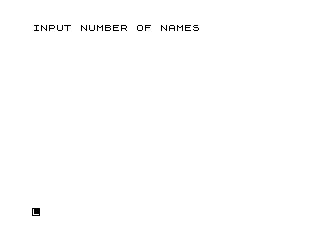
Source Code
   1 REM ADDRESS LABEL
 110 PRINT "INPUT NUMBER OF NAMES"
 120 INPUT N
 121 PRINT N
 130 DIM A$(100,4)
 140 DIM B$(4)
 150 LET B$(1)="NAME"
 160 LET B$(2)="ADDRESS"
 170 LET B$(3)="CITY AND STATE"
 180 LET B$(4)="ZIP CODE"
 190 FOR I=1 TO N
 200 FOR J=1 TO 4
 210 PRINT "INPUT";B$(J)
 220 INPUT A$(I,J)
 230 NEXT J
 232 LET X=LEN (A$(I,1))
 234 IF X<30 THEN GOTO 240
 236 PRINT "PROGRAM ONLY ACCEPTS NAMES UP TO"
 237 PRINT "30 CHARACTERS LONG.TRY AGAIN"
 238 GOTO 220
 240 NEXT I
 250 PRINT
 310 FOR I=1 TO N
 320 PRINT
 340 FOR J=1 TO 4
 350 LPRINT A$(I,J)
 360 NEXT J
 370 NEXT I
 380 STOP
 390 SAVE "1012%5"
 400 RUN
Note: Type-in program listings on this website use ZMAKEBAS notation for graphics characters.