
At 3 AM in the morning ten years ago I was unable to sleep. I was thinking about SNUG, the Sinclair NorthAmerican Users Group, and a group that just couldn’t get off the ground. Its purpose was to be the preservation of Sinclair hardware and software in the United States of America. The fellows trying to get the group going were young working guys that were trying to keep their families going and could not put enough time into SNUG to keep its members happy. I thought up a new organization to do the things promised by the old group headed up by folks that might have more time to devote to the goal. I wrote a letter that would get a new group started to do what the old group couldn’t seem to get going. I would call it T/SNUG, the Timex/Sinclair NorthAmerican User Groups.
It would be represented by the collection of the user groups still in existence at the time and its officers would be from the older crowd that had empty nests at home. It would be the new home for those that would in time lose their present user groups.
Don Lambert was a man who had just retired from Collins Radio and had lost his user group. He had put out a newsletter called the CRAGIST in Cedar Rapids, Iowa and had recently moved to Auburn Indiana. I phoned him and he agreed to become our Chairman. The newsletter name “ZXir QLive Alive!” was the creation of Al Feng who cleverly brought together the ZX of the ZILOG family of machines and the QL for the Motorola chip machines. As for the content of the newsletter, I could supply enough to get us started. I had developed the LogiCall operating system for the LarKen Disk Drive interface which Larry Kenny himself told me he wished he had gone with LogiCall instead of the system from Florida. For years I had submitted programs to the T/S rags only to never see them get into print. Now was my chance to get the word out about the power of the LarKen/LogiCall marriage, which allowed the TS-2068 to switch between the Spectrum ROM and the TS-2068 ROM on the fly.
By the way, the final version of LogiCall was released to ender Frank Davis of FWD Computing in 1995 in time to sell at the Dayton ComputerFest. When I attended the 1996 Dayton ComputerFest, Frank reminded me that it had been one year since Gates released Windows 95. More than 5000 bugs were found in it. Frank then went on to say, “LogiCall has also been out there one year and no one has found any bugs in IT yet.” … And no one ever has! Thanks, Frank! Frank and Carol Davis still do our local “Chicago Color ComputerFest” every year. Thanks Again, Frank And Carol!
At 3 AM this morning I am up again, not for the same reason as ten years ago, but rather, to go to the bathroom. I know of no Timex/Sinclair group that still meets. I do know a few guys that still claim to step up to the T/S machines from time to time. My two TS-2068s are presently safely stored away until I can get time to bring them back to life again this fall when I get rid of a couple of high priority honey-do jobs my wife laid on me.
Alas! A next stage for T/SNUG has come to pass. Abed no longer gets input for our ZQA! Newsletter. It is now time to publish and mail our last ZXir QLive Alive! Newsletter. Abed and I met back in October and again in March.
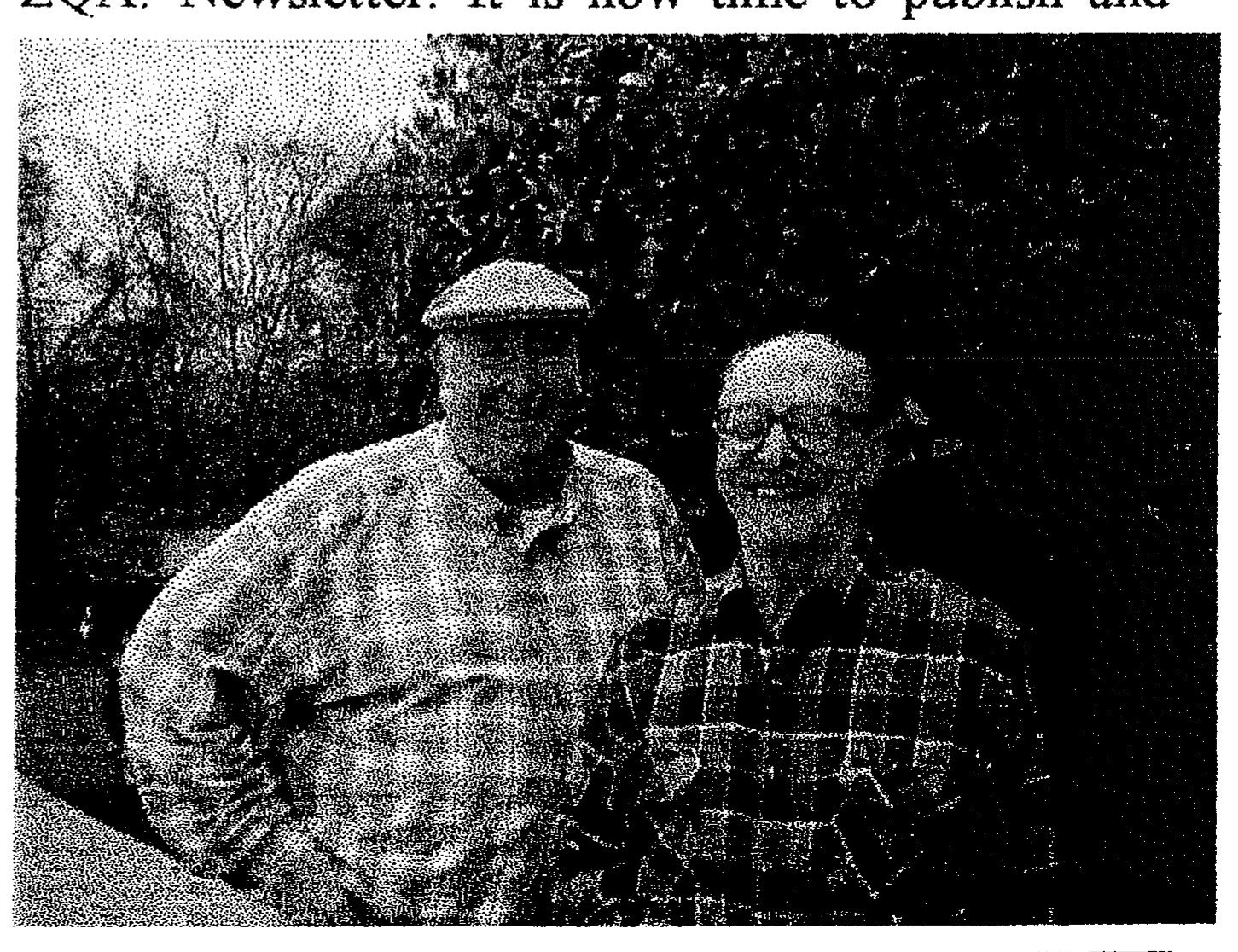
We discussed how the T/SNUG organization could continue. We decided to hold off on this last newsletter to have time to put the next stage into action. In the mean time, along came Jose Moreno in Miami, Florida requesting that he be allowed to put up a web site called ZQA (he forgot the “!”). We believe he is hoping to keep the e-mail portion of the newsletter alive but to date. I can’t figure out how to read the inputs that go to that web site.
Then there is Callum Davidson who will simply keep the newsletter on the web site and will send a printed copy only to those who want to pay for the hard copy. I also hope to see him have a LarKen TS-2068 by the end of 2003 to keep his interest up. The Timex stuff is new to him as he is really a Spectrum man. LarKen will let him switch between the two and will enable him to get up to speed on the TS-2068.
What Abed and I decided to do is to take any inputs we get and put them into a continuously growing newsletter that can be read only on the T/SNUG web site at
http://members.aol.com/clubbbs/tsnug/
No more mailed hard copies, no more dues. We will try to keep you all abreast of what is available in terms of hardware at our remaining hardware storage site in Iowa. Please also remember that you can contribute your T/S related hardware to the site rather than sending it to a landfill. The contact information is in the Unclassified Ads of this last newsletter.
Just get on the Internet and bookmark our web site and check it out from time to time. Now that I, too, am retired, I hope to update our site with changes more often. It really is up to you all to keep things alive, keep e-mailing Abed, and me even just to say hello once in a while. That is what it takes to keep it going. And of course, Abed – thanks again for all your hard work. You have been the greatest asset that T/SNUG has had these past eleven years. And thanks to J Shepard, Jack Boatwright and all the generous people that have made our hardware availability a reality to this day. We all have been an unusual group of users.
Bob –==GATOR==– Swoger, K9WVY
Back in the early 70’s, at my place of work, we (engineering department) were allowed to log on the company’s IBM 360 mainframe when it was not in use by the accounting department. I learned BASICA by a visit to IBM in downtown Chicago. Later we had Time-Share and were able to use IBM’s downtown computer, logging on using the telephone (50 BAUD) and a printer.
A couple years later, we got CompuServe and a monitor, we still had to dial up and enter our code to get online. I never really got to fully put to use the BASICA language because of the limitations on allotted time and the connect charges.
The end of the 1970’s, the company got a Commodore 64 for my office. In 1979 I saw an ad in an engineering magazine for the Sinclair ZX-80 for $200, then a ZX-80 in kit form for $99. I got and built that kit pronto and learned the BASIC language.
In 1980, I got the ZX-81 and immediately updated its 1K RAM. There were magazines articles and newsletters devoted to it.
The TS-2068 appeared in 1982, color, 64K RAM, printer, 300 BAUD modem, etc…… I didn’t waste any time buying one. Various magazines began to cover all aspects of the TS-2068 and there were plenty of writers and suppliers of add-ons and attachments, and many newsletters. I acquired the LarKen and a disk drive, later on, the LogiCall.
End of 1980’s, I joined the Chicago CATUG group. Bob Swoger published a newsletter. Later on he published ZQA!. He was having difficulties in meeting the deadlines of two N/Ls with his full time job, so I, retired by that time, took over the publishing up to this date.
Abed Kahale