
– Jan 12/90
– (Updated Feb 23/90)
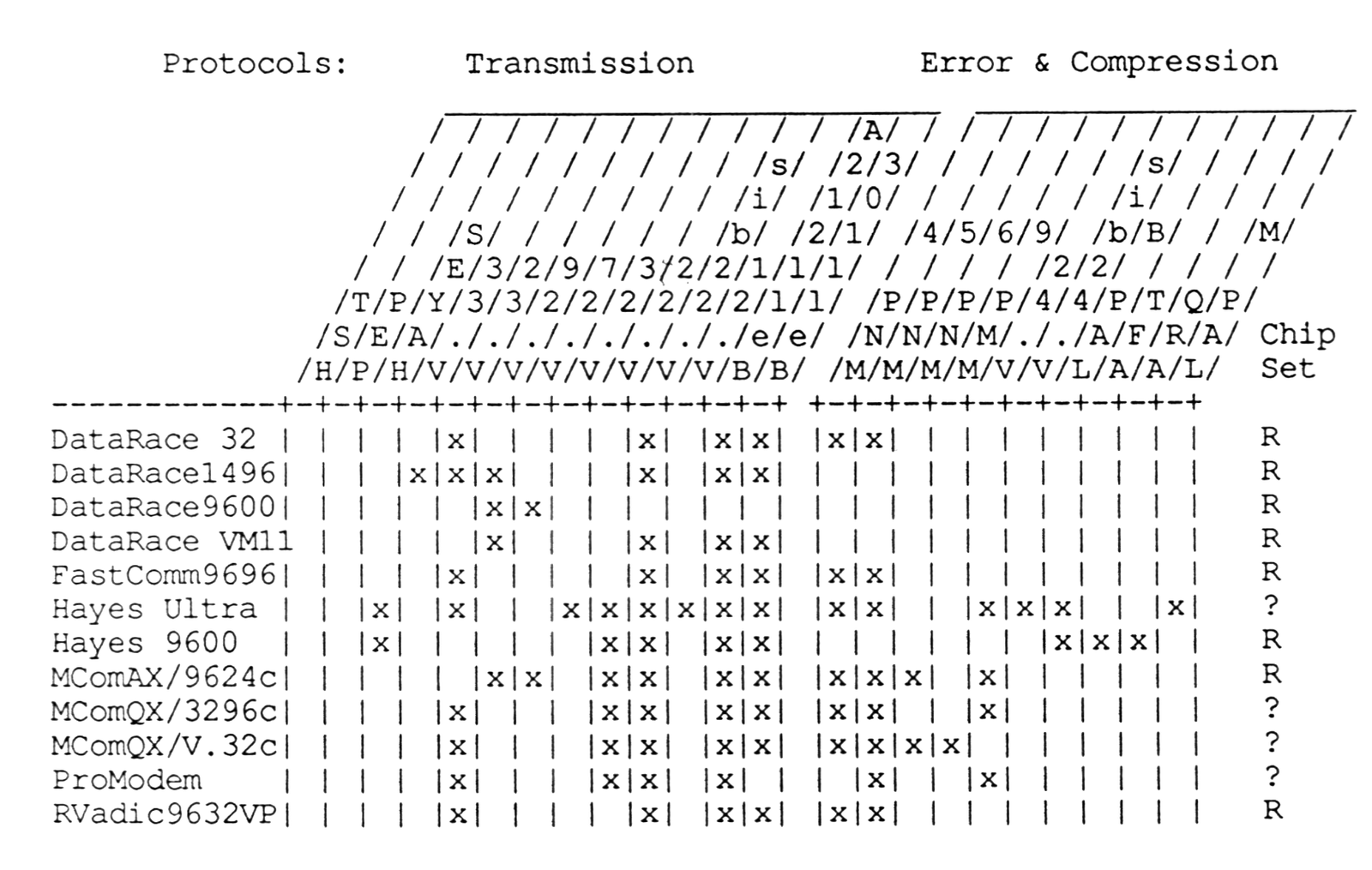
I have been collecting information on 9600 baud modems for a while now and I finally got around to making up the table below. I have used the manufacturer’s data sheets for this info, so take it with a grain of salt. I have seen it said that some products support various protocols, but I simply went by the data sheets.
The modems:
----------
Data Race Action 32
Data Race Action 1496
Data Race Rally 9600
Data Race VM 1
Fastcomm FDX 9696
Hayes Ultra
Hayes V-series Smartmodem 9600
Microcom AX/9624c
Microcom QX/3296c
Microcom QX/V.32c
Prometheus ProModem 9600 Plus
Racal-Vadic 9632PA
Racal-Vadic 9632VP
Telcor 3238
Telcor 2938
Telcor 3264PC
Telebit T1000
Telebit T2500
Telebit TrailBlazer Plus
USR Courier HST
USR Courier HST Dual Standard
USR Courier HST/ix (for Unix systems)
USR Courier V.32
      Protocols:      Transmission            Error & Compression

                     __________________________  ____________________
                    / / / / / / / / / / / /A/ / / / / / / / / / / / /
                   / / / / / / / / / /s/ /2/3/ / / / / / /s/ / / / /
                  / / / / / / / / / /i/ /1/0/ / / / / / /i/ / / / /
                 / / /S/ / / / / / /b/ /2/1/ /4/5/6/9/ /b/B/ / /M/
                / / /E/3/2/9/7/3/2/2/1/1/1/ / / / / /2/2/ / / / /
               /T/P/Y/3/3/2/2/2/2/2/2/1/1/ /P/P/P/P/4/4/P/T/Q/P/
              /S/E/A/././././././././e/e/ /N/N/N/M/././A/F/R/A/ Chip
             /H/P/H/V/V/V/V/V/V/V/V/B/B/ /M/M/M/M/V/V/L/A/A/L/  Set
------------+-+-+-+-+-+-+-+-+-+-+-+-+-+ +-+-+-+-+-+-+-+-+-+-+
DataRace 32 | | | | |x| | | | |x| |x|x| |x|x| | | | | | | | |   R
DataRace1496| | | |x|x|x| | | |x| |x|x| | | | | | | | | | | |   R
DataRace9600| | | | | |x|x| | | | | | | | | | | | | | | | | |   R
DataRace VM11 | | | | |x| | | |x| |x|x| | | | | | | | | | | |   R
FastComm9696| | | | |x| | | | |x| |x|x| |x|x| | | | | | | | |   R
Hayes Ultra | | |x| |x| | |x|x|x|x|x|x| |x|x| | |x|x|x| | |x|   ?
Hayes 9600  | | |x| | | | | |x|x| |x|x| | | | | | | |x|x|x| |   R
MComAX/9624c| | | | | |x|x| |x|x| |x|x| |x|x|x| |x| | | | | |   R
MComQX/3296c| | | | |x| | | |x|x| |x|x| |x|x| | |x| | | | | |   ?
MComQX/V.32c| | | | |x| | | |x|x| |x|x| |x|x|x|x| | | | | | |   ?
ProModem    | | | | |x| | | |x|x| |x| | | |x| | |x| | | | | |   ?
RVadic9632VP| | | | |x| | | | |x| |x|x| |x|x| | | | | | | | |   R
View the printed page (Protocols table, part 1: Transmission and Error & Compression protocols supported by each modem, with chip set (DataRace 32 to RVadic9632VP))
RVadic9632PA| | | | |x| | | |x|x| |x|x| |x|x| | | | | | | | |   R
Telcor3264PC| | | | |x| | | | |x| |x|x| |x|x| | |x|x| | | |x| * R
Telcor 2938 | | | | | |x| | | |x| |x|x| |x|x|x| | | | | | | | * R
Telcor 3238 | | | | |x| | | | |x| |x|x| |x|x| | | | | | | | | * R
T1000       | |x| | | | | | |x|x| |x|x| |x|x| | | | | | | | |   ?
T2500       | |x| | |x| | |x|x|x|x|x|x| |x|x| | | | | | | | |   ?
TBlazer+    | |x| | | | | | |x|x| |x|x| |x|x| | | | | | | | |   C1
USR HST     |x| | | | | | | |x|x|x|x|x| |x|x| | |x|x| | | | |   C2
USR V.32    | | | | |x| | | |x|x|x|x|x| |x|x| | |x|x| | | | |   C2
USR HST-DS  |x| | | |x| | | |x|x|x|x|x| |x|x| | |x|x| | | | |   C2
------------+-+-+-+-+-+-+-+-+-+-+-+-+-+ +-+-+-+-+-+-+-+-+-+-+
View the printed page (Protocols table, part 2 (RVadic9632PA to USR HST-DS))
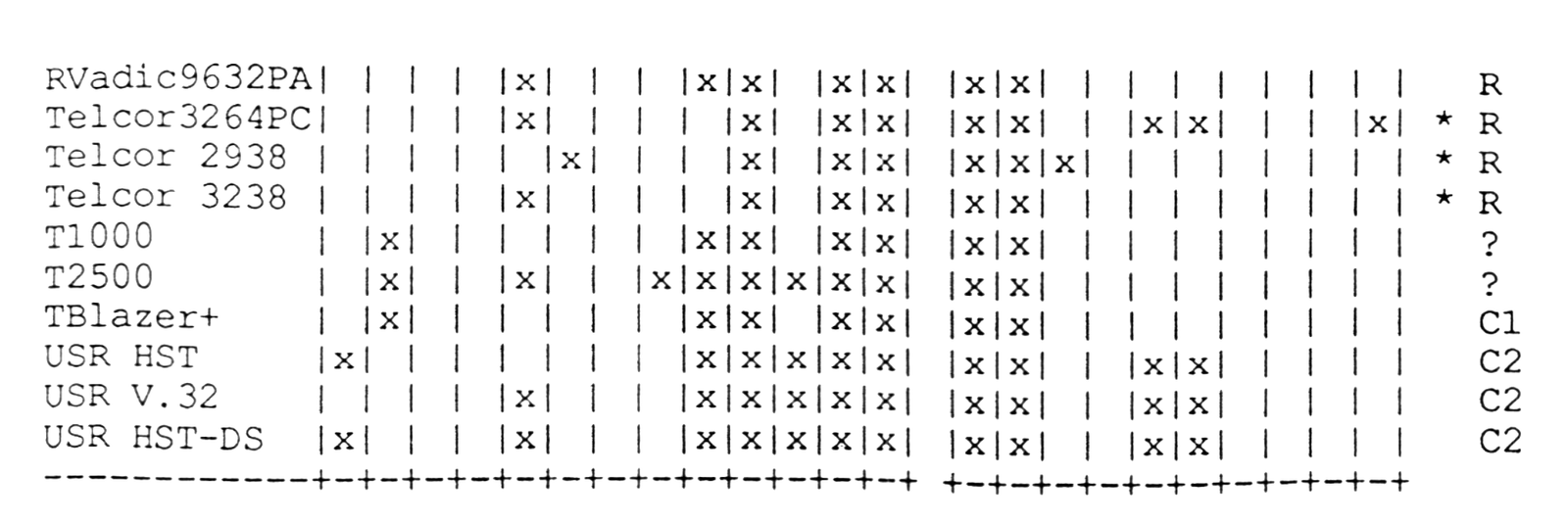
ChipSet: R = Rockwell chipset
         C1 = TMS32010
         C2 = TMS32020
HST - (High Speed asynchronous Transmissions) is a proprietary US
      Robotics 9600 baud transmission protocol. [ 9600 and/or 14400
      bps, asymmetrical modulation ("back channel" at reduced
      (300 or 450) bps)]
PEP - (Packetized Ensemble Protocol) is a proprietary Telebit 9600
      baud transmission protocol. ("ping-pong")
      The TB+ also has "Protocol spoofing" to turn xmodem, kermit,
      and UUCP G file transfers into streaming protocols.
HAYES - a proprietary "ping-pong" 9600 baud protocol.
LAP-B - Link Access Procedure Balanced
ARQ   - Proprietary Hayes Error Correction/Link protocol
AFT   - Proprietary Hayes Error Correction/Link protocol
LAP-M - Part of V.42 Link Access Procedure for Modems
* - Telcor has proprietary Error correction (Telcor CRC-16) &
    data compression.

Bell 103:  300 bps, full-duplex, FSK encoding
V.21    :  300 bps, full-duplex, FSK encoding
Bell 212: 1200 bps, full-duplex, DPSK encoding
V.22    : 1200 bps, full-duplex, DPSK encoding
V.23    : 1200/75,75/1200 bps, full duplex DPSK encoding
V.22bis : 2400 bps, full duplex, QAM encoding
V.27    : 4800 bps, half duplex, tribit encoding
V.29    : 9600 bps, half duplex
V.32    : 9600 bps, full-duplex, Trellis encoding with echo cancellation
          4800 bps (V.32 "fallback" speed)
V.33    : 9600, 12000, 14400 bps 4 wire leased line
-----------------------------------
FSK  = Frequency Shift Keying
DPSK = Differential Phase-shift Keying
QAM  = Quadrature Amplitude Modeulation
Trellis is a modified QAM
-----------------------------------
V.42
A CCITT error correction standard much like MNP4. In fact, because V.42 includes MNP4, all MNP modems establish error-controlled connections with V.42 modems. Error correction technology copes with phone line imparments by automatically restrIn;mitting corrupted data. ALL U>S> Robotics high speed modems (Courier HST and Courier V.32) and the courier 2400e currently incorporate MNP and therefore V.42 compatible.
V.42bis
A CCITT data compression standard similar to MNP5, but providing about 35% better compression – thus better throughtput. To negotiate a standard connection using V.42bis requires V.42. Thus a modem with V.42bis data compression is assumed to include V.42 error correction. All U.S. Robotics high speed modems (Courier HST DUAL STANDARD, Courier HST and Courier V.32) and the Courier 2400e will incorporate V.42bis data compression by early 1990. Data compression increases transmission speed by reducing the number of bits to be sent. The file compressed by the transmitting modem and decompressed by the receiving modem. The sending and receiving systems must both use the same rules of compression and decompression.
X.25 is a DIGITAL packetised transmission standard for PDN’s it will support multiple simultaneous sessions on Timenet, Telenet , and AT&T PDN the Hayes can use X.25 instead of V.32 under V.42bis as an option.
X.25 and X.75 modems are called PADS not MODEMS since they are Digital not MODulated.
The term PAD stands for Packet Assembler/Disassembler Trailblazer modems can chat at 19.2 kbps and can achieve an actual throughput of 18,000 baud WITHOUT COMPRESSION. This means that ARC files for example will be transfered at 18,000 baud.
References
----------
FidoNet HST conference
comp.dcom.modems Usenet
BYTE - Mar/83, Page 26; Circuit Cellar by Steve Ciarcia
BYTE - Nov/85, Page 89; Circuit Cellar by Steve Ciarcia
MIPS -Dec/89,Page 44; Fast Talking by William L. Rinko-Gay
BYTE -June/89,Page 162; 4800 Bits, No Errors by S. Apike & S.Diehl
BYTE -June/89,Page 321; Modern Modem Methods by L.Brett Glass
BYTE -Jan/89,Page 281; Whither the Modem? by J.H. Humphrey & G.S.Smock
BYTE -June/88,Page 102; High-Speed Modems by J.H. Humphrey & G.S.Smock
Computer Shopper -Feb/88,Page 9; Speeding along at 9600 Baud by Ted Drude
Computer Shopper -Feb/90,Page 243; LightSpeed 9624E Modem by Ted Drude
EXAR - XR-212AS Modem Design Booklet
Texas Instruments - TMS99532 Data Manual
CCITT Volume VIII.1 Series V Recommendations
Understanding Telephone Electronics by TI Learning Centre (Radio Shack)
The Theory and practice of Modem Design by John Bingham 1988
              Wiley Interscience ISBN 0-471-85108-6
>eof