
I don’t know who was the first to call the Chaos Game a game; whoever did certianly overrated it, since it would be tedious, and messy to play without using a computer. The playing field is a triangular area on a piece of paper, with the vertices numbered 1, 2, and 3. To play, you mark a point, either inside or outside this area, then throw a 3-sided die (or more likely a 6-sided die, and divide by 2). The number that comes up determines to which vertex your line is to go (i.e. 1, 2, or 3) from your marked point to the vertex having that number. You take the mid-point of that line as your next marked point, and throw the die again, to repeat the process. Anyone using paper and pencil to try this out would probably be pretty discouraged at the end of 25 or 30 throws, with no perceptible pattern. It is a bit surprising that, even if you start outside the triangle, the point quickly gets inside, and by about 1000 throws the final pattern has emerged. Even more surprising is that this pattern is a fractel set (which means that the dimension of the set is a FRACTION, between 1 and 2, in this case). A usual additional requirement for a set to be a fractal is that any piece of it should contain inside it an image (or an approximate image) of the original set, and it does qppear that Sierpinski’s Gasket has this property; so does the Mandelbrot Set.
You can convince yourself that Sierpinski’s Gasket has no area by looking at the amount of area that is removed in the process of arriving at the final set. For simplicity, suppose that the original triangle has an area of one. THe middle triangle of area 1/4 has been removed from this, leaving 3 triangles, each of an area 1/4. From each of these a middle triangle is removed, of area (1/4)x(1/4), leaving 9 triangles, each of area (1/4)x(1/4)x(1/4), with 1/4 of each of these removed. So far then, we have removed:
     1/4 + 3x(1/4)x(1/4) +
     9x(1/4)x(1/4)x(1/4) = .578125.
At the next stage, we have removed (3x3x3)/(4x4x4x4) = .1054687 more, which gives .6835937; if this is continued (the next term would be the fraction with four 3’s upstairs, and five 4’s downstairs, i.e. 81/1024, you can believe that the total amount subtracted would add up to one. (A spreadsheet can make this credible, for example). Since we started with a total area of one, we have no area left. (I realize that this may well be more than you ever wanted to know about fractals, but at leat you could skip it if you wished.)
 100 REM The Chaos Game.
 105 REM This produces a fractal
 figure called "Sierpinski's Gas
ket"
 110 REM By Tim Swenson,July 199
0
 120 CLEAR 65535: BORDER  : LET
n=0
 140 PAPER 0: INK 7: CLS
 145 PRINT "   SIERPINSKI'S  GAS
KET"
 150 PLOT 10,10
 160 PLOT 75,135
 170 PLOT 135,10
 180 LET x=RND*99
 190 LET y=RND*99
 210 LET x1=x: LET n=n+1
 220 LET y1=y
 230 LET roll=INT (.5+RND*3)
 240 IF roll=1 THEN  LET x2=10:
LET y2=10
 250 IF roll=2 THEN  LET x2=75:
LET y2=135
 260 IF roll=3 THEN  LET x2=135:
 LET y2=10
 270 LET x=(x1+x2)/2
 280 LET y=(y1+y2)/2
 290 PLOT x,y
 300 IF n/250=INT (n/250) THEN
BEEP .1,.1
 310 GO TO 210
9000 PRINT USR 100: SAVE "chaos.
B1" LINE 1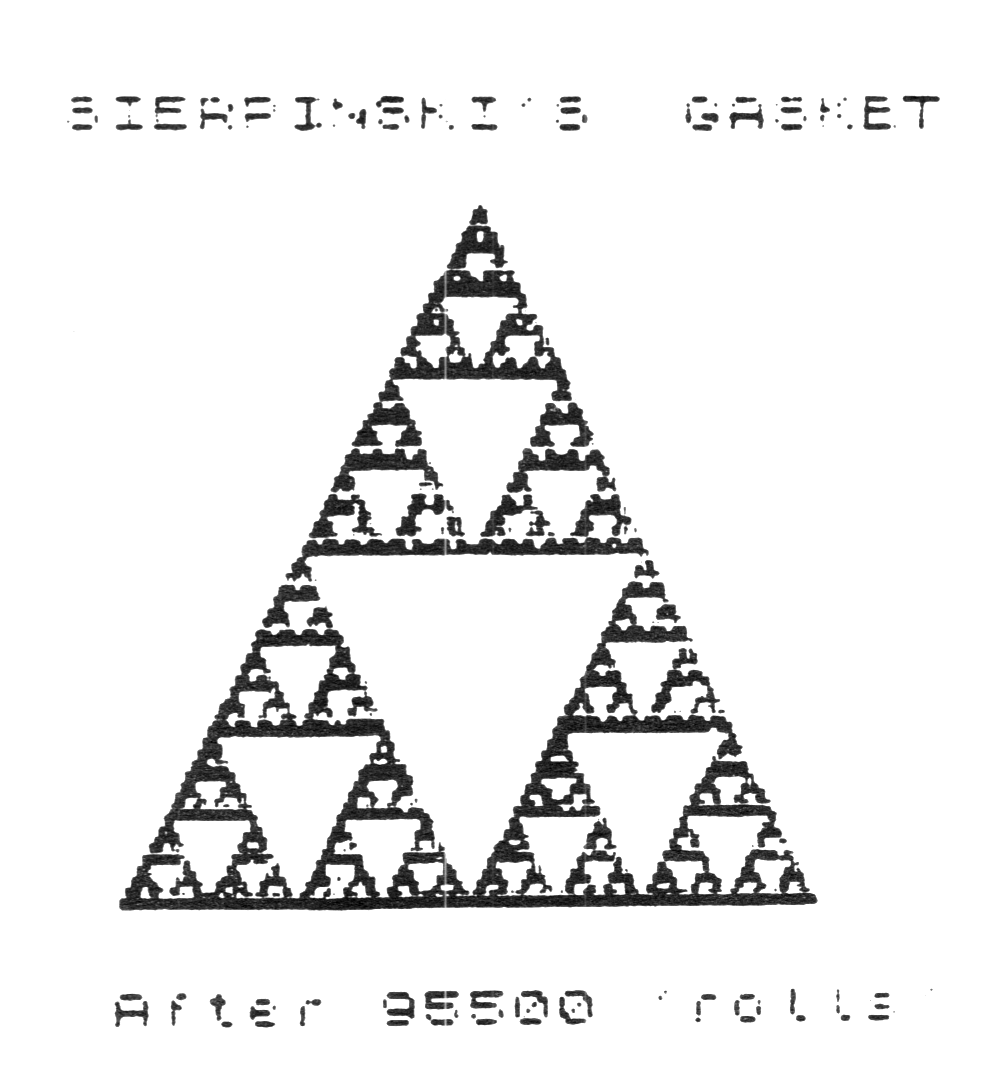
From the Sept-Oct Issue of Sinc-Link, Toronto T/S User Group
Note: Type-in program listings on this website use ZMAKEBAS notation for graphics characters.