
This music utility will allow you to play music using the LPRINT (PRINT #3) command. Once it is switched on with LET L=USR and its address, a line such as LPRINT "t10 o3 -c1 b+1 +a-2 p3" is played as music instead of being printed. t sets the tempo (0 fast to 50 slow), o the octave (0 to 6), a - or + in front of a note drops or raises it an octave, a - or + after it makes it flat or sharp, p is a rest, and the number after a note or rest is its length (1 to 16). Entries are separated by spaces.
MUSIprint was written by Eric Boisvert and published, not copy-protected, on the February 1988 tape (Issue 9) of Byte Power. The magazine says it works on both the TS2068 and the Spectrum. The tape holds a BASIC “customizer” and the 540-byte machine code; MUSIC Demo on the same tape plays five tunes with it.
Program Analysis
The Customizer
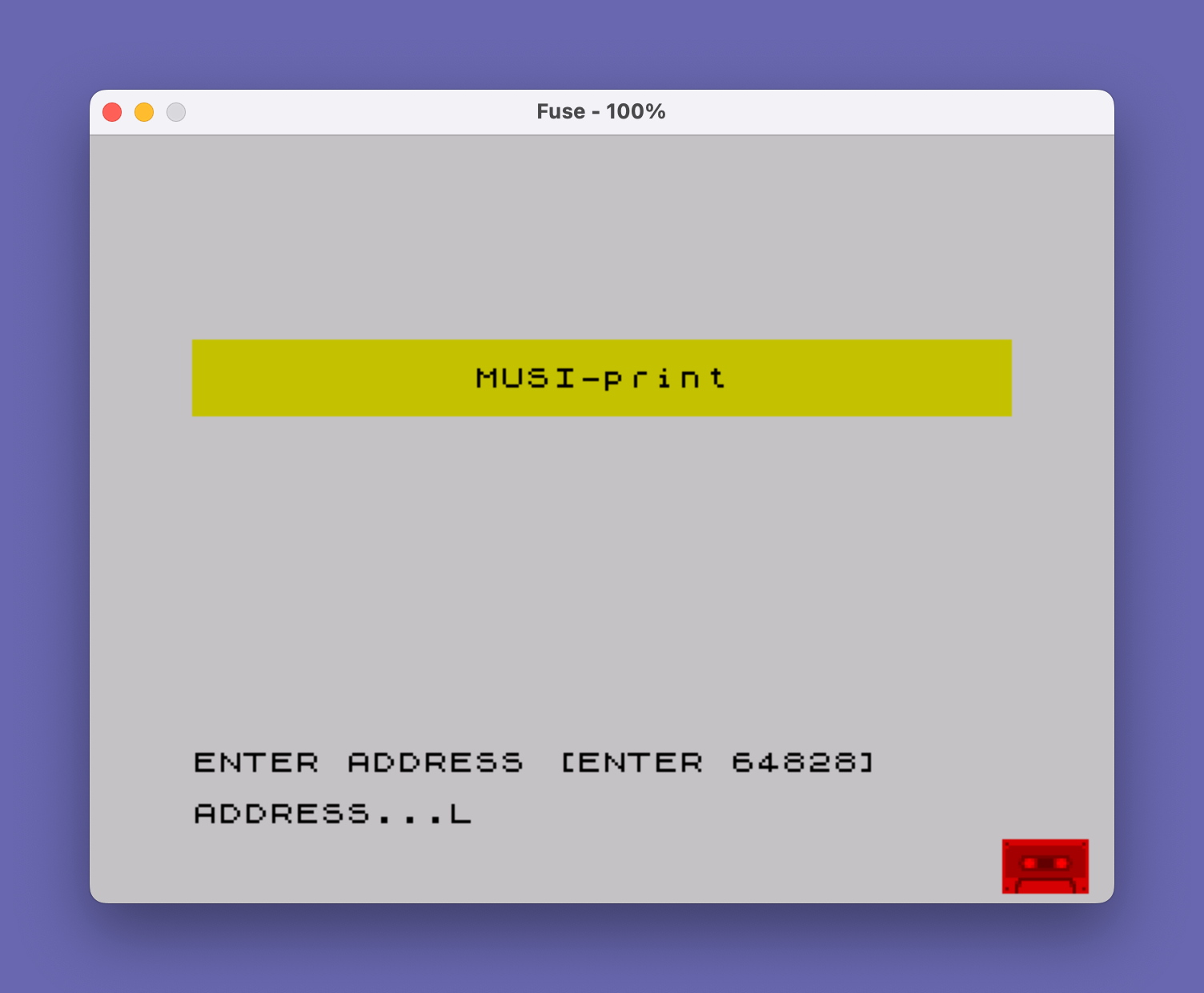
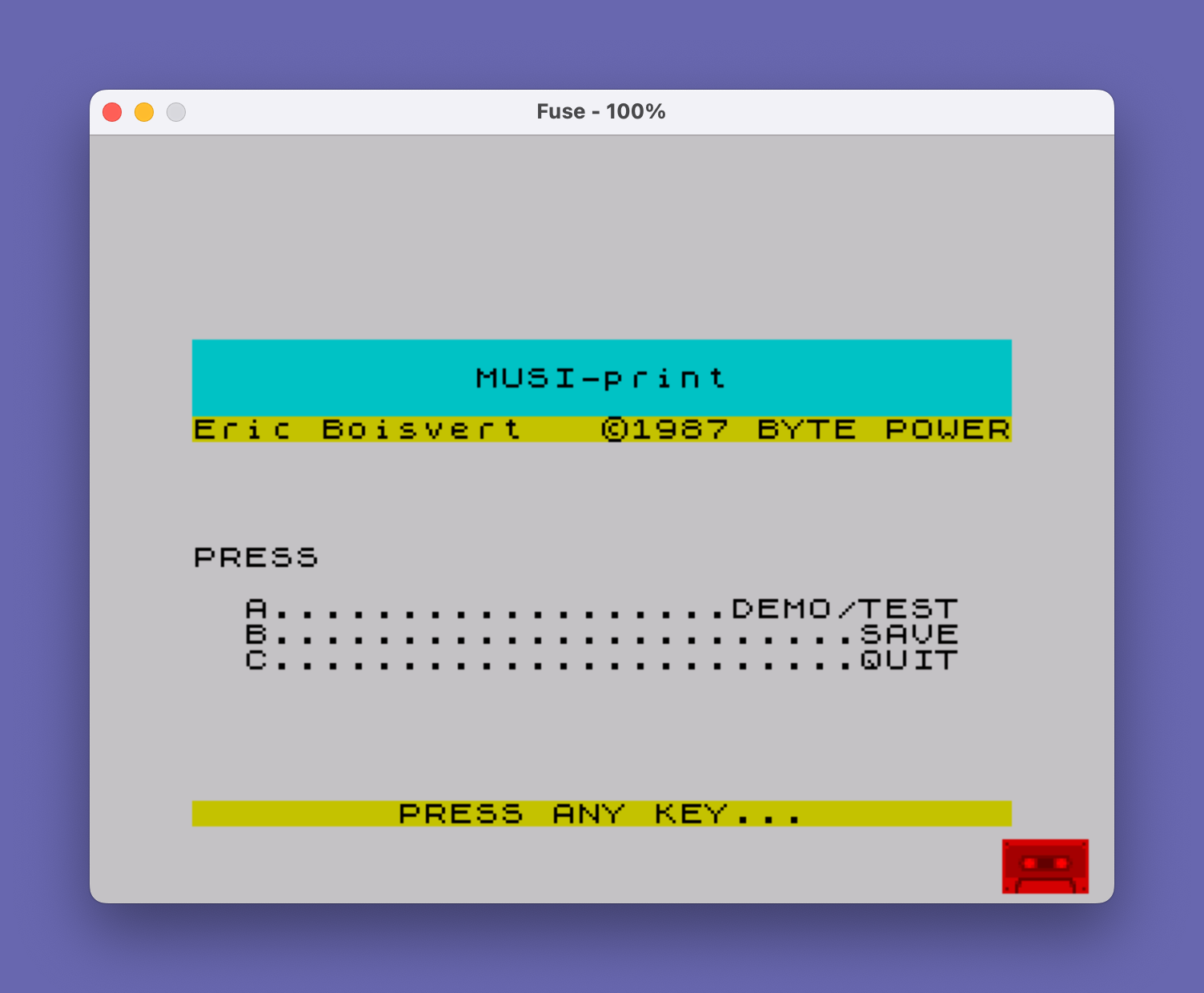
The BASIC program (auto-runs at line 1) sets CLEAR 30000, asks for the address to load the code at (default 64828), loads the MUSIprint code block there and relocates it. It then offers a menu: A switches the utility on and plays a test scale through every octave, B saves the relocated code under a name you choose, with an optional VERIFY, and C stops. After saving, the screen gives the LET L=USR call to use in your own programs.
Relocation
Lines 1110–1200 patch 16 two-byte addresses inside the code. Each DATA pair is an offset into the code and the value to store there; values smaller than the load address are taken as offsets and have the load address added. Several pairs give the target as the letter A, which READ evaluates as the current value of the variable A, so the previous target is reused without being written out again.
Notable Techniques
- Music commands are sent through the printer stream (
LPRINTorPRINT #3), so a tune is just a string - A relocation table in
DATAlets the code run at any address the user picks DATAitems written as the variable nameArepeat the last value read- Line 9999 saves both the customizer and the code at the chosen address
Potential Issues
- The address you type is not checked. The program has already done
CLEAR 30000, so an address below that, or one above 64996 (where 540 bytes would run past 65535), will not work.
Image Gallery
Note: Type-in program listings on this website use ZMAKEBAS notation for graphics characters.