
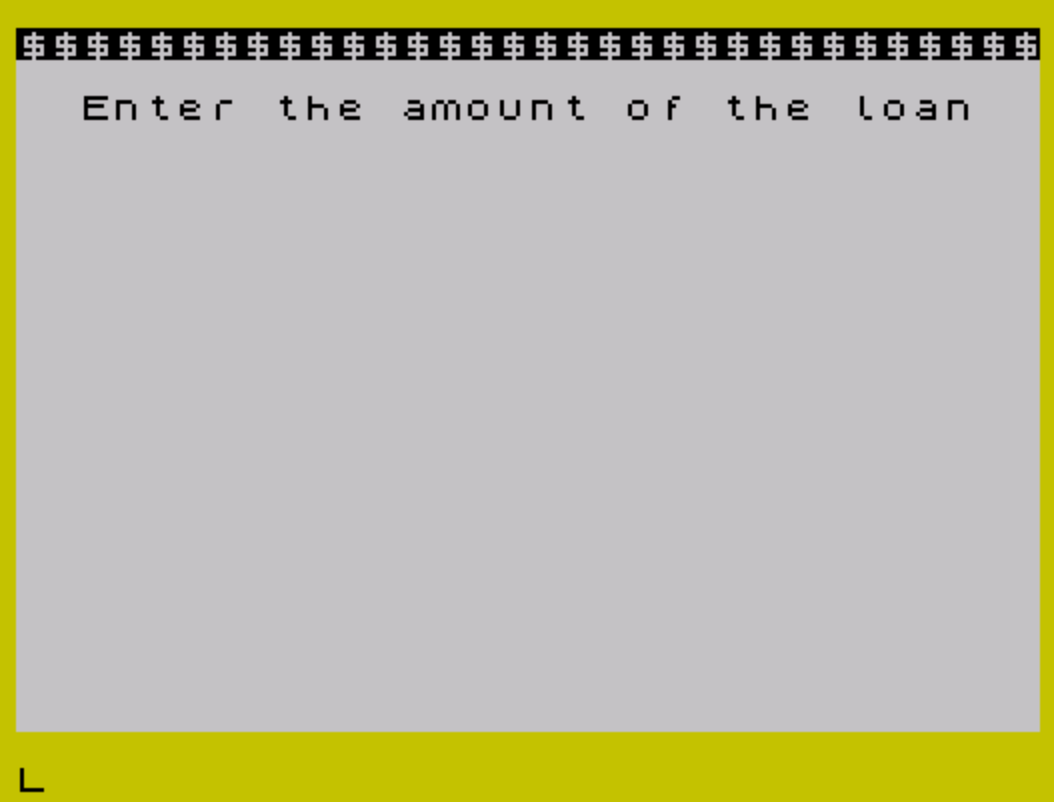
This program calculates monthly loan payments using the standard amortization formula: monthly payment = principal × monthly_rate / (1 − (1 + monthly_rate)^−n). It accepts a loan amount, number of monthly payments, and annual interest rate as inputs, then displays both the monthly and total payment figures. Display formatting uses FOR/NEXT loops at lines 500 and 600 to draw decorative separator bars of inverse-video dollar signs and dashes across the full 32-column width. Line 9999 provides a save/verify routine that stores the program with an auto-run entry point at line 1.
Program Analysis
Program Structure
The program is organized into a linear main flow (lines 5–185) with two reusable display subroutines (lines 500–650) and a standalone save routine at line 9999. Control flow is straightforward: gather three inputs, compute the monthly payment, display results, then offer a copy/repeat menu.
| Line Range | Purpose |
|---|---|
| 5 | REM header with author and version |
| 10–20 | Initialization: CLS, BORDER, variable reset, opening banner |
| 25–110 | Input section: loan amount, number of payments, annual interest rate |
| 115–160 | Calculation and results display |
| 165–185 | Post-result menu: print copy or restart |
| 500–550 | Subroutine: 32-character inverse-video “$” separator bar |
| 600–650 | Subroutine: 32-character “-” separator bar |
| 9999 | Save/verify utility |
Amortization Formula
The core calculation occupies lines 110–125. Line 110 converts the user-supplied annual percentage rate to a monthly decimal rate: i = (0.01 * i) / 12. Line 120 applies the standard amortization formula:
p = t * i / (1 - 1 / (1 + i) ^ n)
where t is the principal, i is the monthly rate, and n is the number of payments. Line 125 rounds the result to the nearest cent using the classic idiom INT(100 * p + 0.5) / 100.
Display Techniques
Two separator-bar subroutines use FOR/NEXT loops running exactly 32 iterations to fill the screen width. The subroutine at line 500 prints inverse-video "$" characters to create a highlighted border effect, while the one at line 600 prints plain "-" dashes. Each input value is echoed back on the screen using INVERSE 1 with TAB positioning (lines 45, 75, 105), giving a form-entry feel.
Input and Menu Handling
Line 165 uses a compound INPUT statement with embedded INVERSE attributes to display a styled prompt asking the user to choose between printing a copy ("1") or running again ("2"). Line 170 handles the LPRINT option, reconstructing the original annual rate from the stored monthly decimal by computing i * 1200 for display. Line 175 restarts the program by jumping to line 1 (which does not exist), causing the program to terminate — this is a known idiom for a clean restart that falls through to the end. Line 180 loops back to the menu if neither valid choice is entered.
Notable Techniques and Anomalies
- Line 15 initializes
p=0explicitly, which is unnecessary since BASIC variables default to zero, but serves as self-documentation. - The GO TO 1 at line 175 targets a non-existent line; execution stops rather than truly restarting. A correct restart would target line 10 or use
RUN. - The LPRINT line (170) is very long, combining column headers and computed values in a single statement, relying on the printer’s 32-column (or wider) carriage width for readability.
- Line 9999 is intentionally isolated and only reached manually, providing a convenient save-and-verify workflow without interfering with normal program execution.
- The variable
lis reused as the loop counter in both separator subroutines, which is safe since the subroutines are never called from within each other.
Image Gallery
Source Code
    5 REM loancompar - J. Colonna        Version 1.1  Rev. 7-86
   10 CLS : BORDER 6
   15 LET p=0
   20 GO SUB 500
   25 PRINT : PRINT
   30 PRINT "  Enter the amount of the loan"
   35 PRINT
   40 INPUT t
   45 PRINT TAB 14; INVERSE 1;t
   50 GO SUB 600
   55 PRINT
   60 PRINT "Enter number of monthly payments"
   65 PRINT
   70 INPUT n
   75 PRINT TAB 15; INVERSE 1;n
   80 GO SUB 600
   85 PRINT
   90 PRINT " Enter the annual interest rate"
   95 PRINT "     (For Example - 12.5)"
  100 INPUT i
  105 PRINT TAB 13; INVERSE 1;i;" %"
  110 LET i=(0.01*i)/12
  115 PRINT
  120 LET p=t*i/(1-1/(1+i)^n)
  125 LET p=INT (100*p+.5)/100
  130 GO SUB 500
  135 PRINT : PRINT
  140 PRINT "Monthly payment will be: $";p
  145 PRINT
  150 PRINT "Total payment will be: $";p*n
  155 PRINT
  160 GO SUB 500
  165 INPUT INVERSE 1;"COPY(1) or AGAIN(2)?"; INVERSE 0;" ";a$
  170 IF a$="1" THEN LPRINT ; INVERSE 1;" AMT.  NUMBER OF  INT.  MONTHLY  LOAN  PAYMENTS   RATE  PAYMENT "; INVERSE 0;"$";t;"     ";n;"       ";i*1200;"%   $";p: LPRINT
  175 IF a$="2" THEN GO TO 1
  180 GO TO 165
  185 STOP
  500 FOR l=1 TO 32: PRINT INVERSE 1;"$";: NEXT l
  550 RETURN
  600 FOR l=1 TO 32: PRINT "-";: NEXT l
  650 RETURN
 9999 CLEAR : CLS : SAVE "loancompar" LINE 1: BEEP 1,25: PRINT "loancompar SAVED": VERIFY "": PRINT "Program VERIFIED": BEEP .5,32: BEEP .5,32
Note: Type-in program listings on this website use ZMAKEBAS notation for graphics characters.