
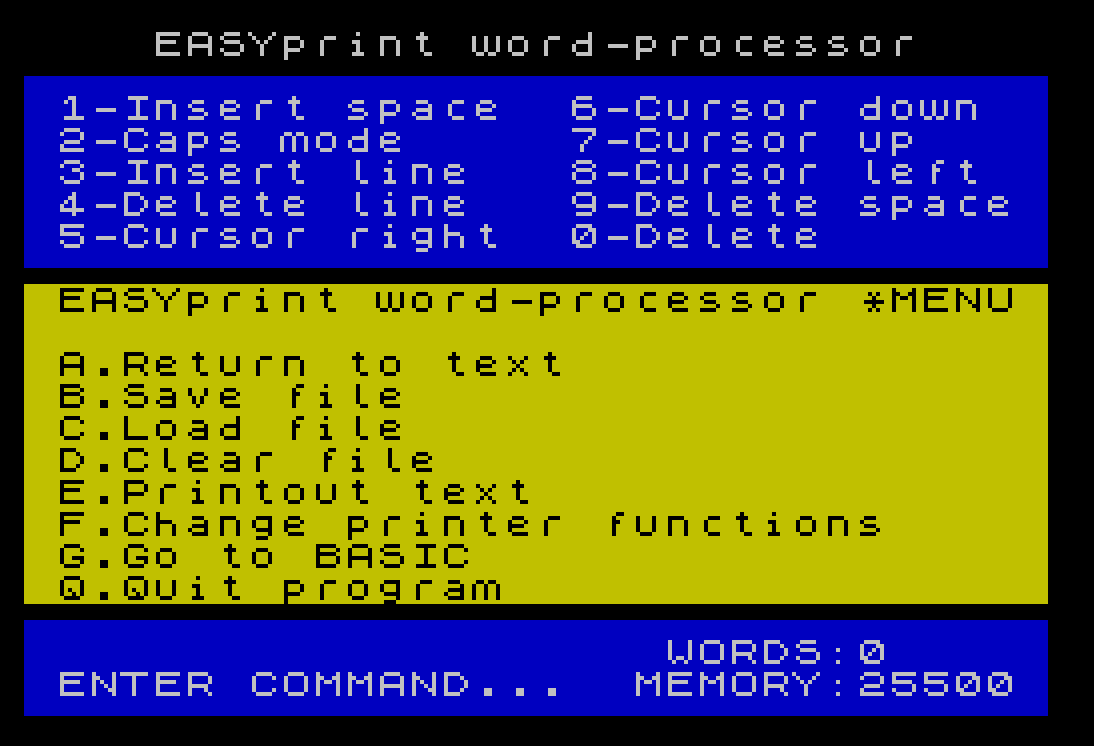
EASYprint is a text-file editor/printer utility that uses a machine-code module loaded from tape to handle its core functionality. The program manages memory carefully, using CLEAR to set up a workspace at address 28100 and mapping a second RAM bank region starting at 53630 for the machine-code routines. On startup it displays a decorative border using repeated character sequences and shows author and copyright information before handing control to the machine-code entry point at 53872 via RANDOMIZE USR. The save routine at line 9999 preserves three separate CODE blocks—a small 246-byte block at 29696, and a 10370-byte machine-code block at 53630—alongside the BASIC loader.
Program Structure
The program is organized into several distinct functional sections, each separated by REM labels:
- Lines 10–110: Main loader/initializer — sets up screen, loads machine code, displays UI, then jumps into the machine-code main loop.
- Lines 1000–1020: Save text file routine — prompts for filename via subroutine, then saves the text buffer as a CODE block.
- Lines 2000–2020: Load text file routine — prompts for filename, calls a machine-code loader helper, then loads the CODE block.
- Lines 3000–3010: Filename input subroutine — uses
INPUT LINEand validates length ≤ 10 characters. - Lines 8000–8020: Save customized version — saves both BASIC and the two CODE blocks for a customized build.
- Lines 9900, 9950: Utility stubs —
CLEAR 65535: NEWand a secondary autorun loader stub. - Lines 9998–9999: Save original version — preserves the full three-part tape image (BASIC + two CODE blocks).
Memory Map
| Address | Size | Purpose |
|---|---|---|
| 28100 | variable | Text file buffer (CODE load/save target) |
| 29696 | 246 bytes | Small auxiliary CODE block (original save) |
| 53630 | 10370 bytes | Main machine-code module |
The CLEAR VAL "28099" at line 15 sets RAMTOP just below the text buffer, protecting the machine-code area from BASIC’s memory management. POKE 23607,115 adjusts the system variable STKBOT high byte, and POKE 23606,0 / POKE 23607,60 at lines 15 and 70 manipulate the ERR_SP/STKEND system variables to control stack or channel behaviour around the machine-code calls.
Machine-Code Entry Points
| Address | Called at line | Apparent role |
|---|---|---|
| 53872 | 1030 | Main UI / editor loop entry |
| 53630 | 100 | Conditional restart (if PEEK 23681 ≠ 0) |
| 63687 | 2010 | Pre-load helper (possibly clears buffer) |
| 63728 | 1020 | Returns text buffer length for SAVE CODE |
Notable BASIC Idioms
VAL "number"is used pervasively for numeric literals inGO TO,GO SUB,POKE, andFORstatements. This is a well-known Sinclair memory optimization: it avoids storing the five-byte floating-point number after the token, reducing BASIC program size at the cost of a runtimeVALevaluation.NOT PIevaluates to0(sincePIis non-zero,NOT PI = 0) and is used as a compact way to write0inFORloop starts andATcoordinates.SGN PIevaluates to1and is used to reference stream#1compactly inPRINT #SGN PI.VAL "3e3"is scientific notation for3000, used inGO SUB VAL "3e3"— another byte-saving trick.- Line 50 uses
PRINT AT x,NOT PI,,— the double comma after the coordinates moves the print position, likely used to trigger a channel/stream side-effect rather than actually printing visible characters.
Startup Display
Lines 20–80 draw a decorative bordered UI before handing off to machine code. The loop from NOT PI (0) to VAL "10" (10) prints ASCII character sequences !"#$%&'()*+,- and ./0123456789:; at mirrored rows (top: row x, bottom: row 21-x), creating a symmetric border. A second loop prints something at column 0 for each mirrored pair of rows. The string " <=", at line 70 is followed by a POKE to system variable 23607, suggesting the trailing comma and the POKE together reconfigure a channel or stream pointer immediately before the machine-code main loop is entered at line 1030.
Image Gallery
Source Code
    0 REM  EASYprint                       by Eric Boisvert                ©1987 BYTE POWER
   10 GO TO VAL "1030"
   15 PAPER VAL "7": INK VAL "0": POKE VAL "23606",VAL "0": CLEAR VAL "28099": POKE VAL "23607",VAL "115"
   20 LOAD ""CODE : FOR x=NOT PI TO VAL "10": PRINT AT x,VAL "9";" !""#$%&'()*+,-";AT VAL "21-x",VAL "9";"./0123456789:;"
   30 NEXT x
   40 FOR x=NOT PI TO VAL "9"
   50 PRINT AT x,NOT PI,,: IF x<>VAL "9" THEN PRINT AT VAL "21-x",NOT PI,,
   60 NEXT x
   70 PRINT AT VAL "12",VAL "9";"      <=",: POKE VAL "23607",VAL "60"
   80 PRINT #SGN PI;AT NOT PI,VAL "4";"Written by Eric Boisvert";AT VAL "2",VAL "3";"Copyright ©1987 BYTE POWER"
   90 INK VAL "7": LOAD "EASYprint"CODE : INK VAL "0"
  100 IF PEEK 23681<>0 THEN RANDOMIZE USR VAL "53630"
  110 LIST 9998: STOP
 1000 REM SAVE TEXT FILE
 1010 GO SUB VAL "3e3": IF n$="" THEN GO TO 1010
 1020 SAVE n$CODE VAL "28100",USR VAL "63728"
 1030 PRINT #2: RANDOMIZE USR VAL "53872"
 2000 REM LOAD TEXT FILE
 2010 GO SUB VAL "3e3": RANDOMIZE USR VAL "63687": LOAD n$CODE VAL "28100"
 2020 GO TO VAL "1030"
 3000 CLS : INPUT "FILE NAME:"; LINE n$: IF LEN n$>VAL "10" THEN GO TO VAL "3e3"
 3010 RETURN
 8000 REM                                                                SAVE CUSTOMIZED VERSION
 8010 SAVE "EASYprint" LINE 9950: SAVE "EASYprint"CODE VAL "53630",VAL "10370"
 8020 VERIFY "": VERIFY ""CODE
 9000 STOP
 9900 CLEAR 65535: NEW
 9950 CLEAR VAL "28099": PRINT #1;AT 1,0;"STILL LOADING...": LOAD ""CODE : RUN
 9998 REM  SAVE ORIGINAL VERSION
 9999 SAVE "EASYprint" LINE VAL "15": SAVE "EASYprint"CODE VAL "29696",VAL "246": SAVE "EASYprint"CODE VAL "53630",VAL "10370": VERIFY "": VERIFY ""CODE : VERIFY ""CODE
Note: Type-in program listings on this website use ZMAKEBAS notation for graphics characters.