Owners of the Sinclair ZX80 and MicroAce rapidly discover that interruptions of power can cause headaches, not to mention the necessity for re-keying programs. If you live in the “Sunshine” state. Florida, you also have to contend with “Florida-Flicker & Flash,” better known as the local utility company. They achieved their reputation by the repeated switching between feeder lines, causing lights to flicker, creating all sorts of problems for computer users.
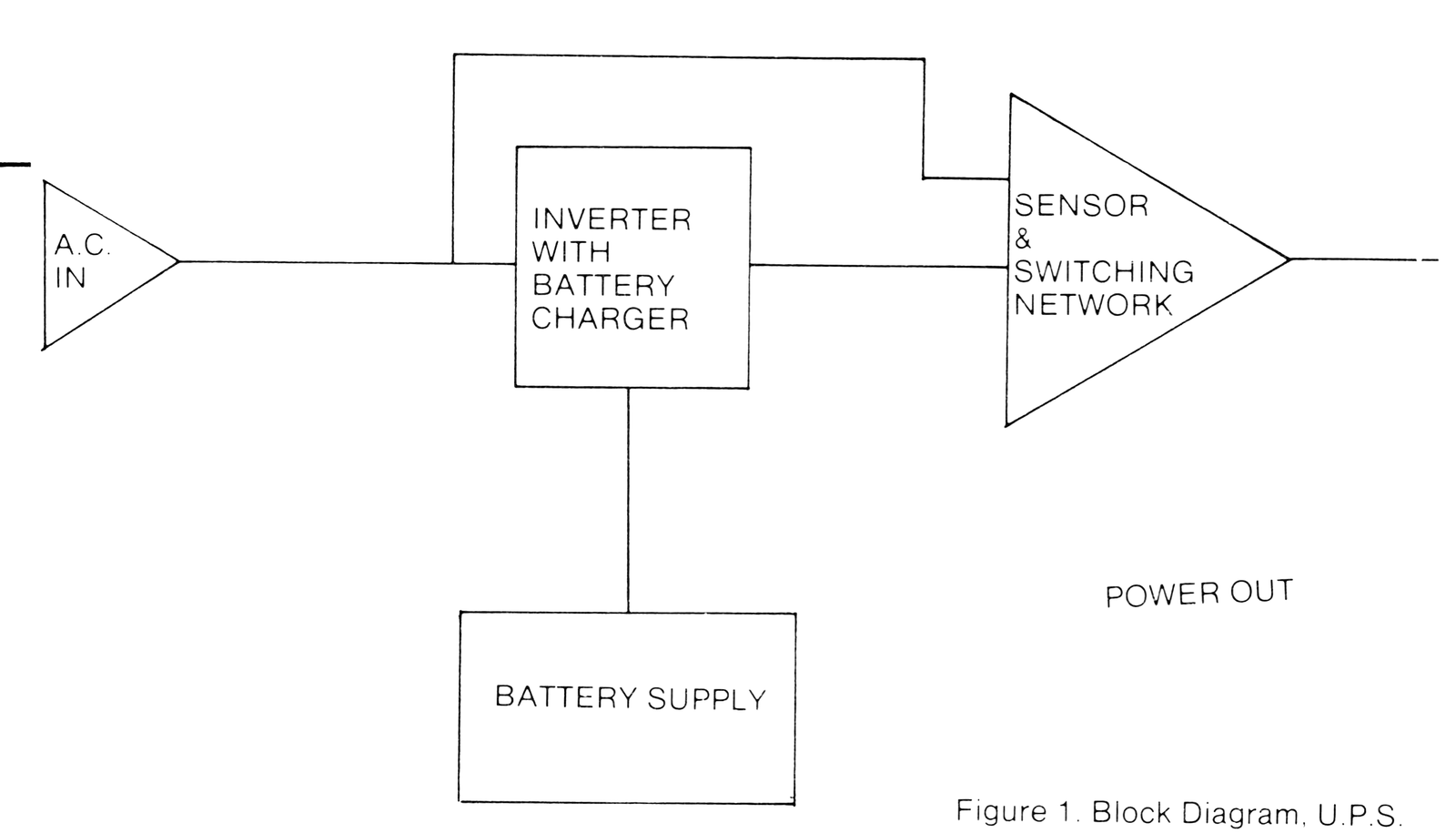
After re-keying several programs into my MicroAce, the Micro-Juice project was born. Most major computer installations use large and expensive line conditioning transformers, filters, and if the area or data is important enough, a device called a U.P.S. The uninterruptable power supply is illustrated in a simple block diagram (figure 1), and generally consists of a device to convert direct current from a storage battery to alternating current, with a switchover network to allow it to take over if commercial power fails. There are several variations on this basic circuit, but generally the U.P.S. allows operation for up to one hour, depending on current requirements, and the size of your budget. This protection doesn’t come cheaply, because U.P.S. systems start at over two hundred dollars.
It makes little sense to spend two-hundred or more dollars for a ZX80 U.P.S., but Micro-Juice serves the purpose for about $10. Fortunately, the ZX80 and the MicroAce were well designed for this addition. Tests on my MicroAce showed that the unit drew approximately 330 mA in use, and the d.c. input from the power supply was about 14 Volts unloaded, with the on-board five volt regulator handling the transition to the five volts the ZX80 needs.
All we wanted to do was to insure that the computer and its memory would remain powered during a power flicker or loss. To do this we needed a source of d.c. somewhere between 5 and 15 volts, supplying 330 mA for about an hour. The transition would have to be so quick as to not disturb the memory. Another requirement was that the Micro-Juicer had to be easy to build and duplicate, using easily obtained parts, and represent as good a value as the computer itself. Considering all those requirements, I was both pleased and surprised to be able to come up a circuit meeting all these needs.
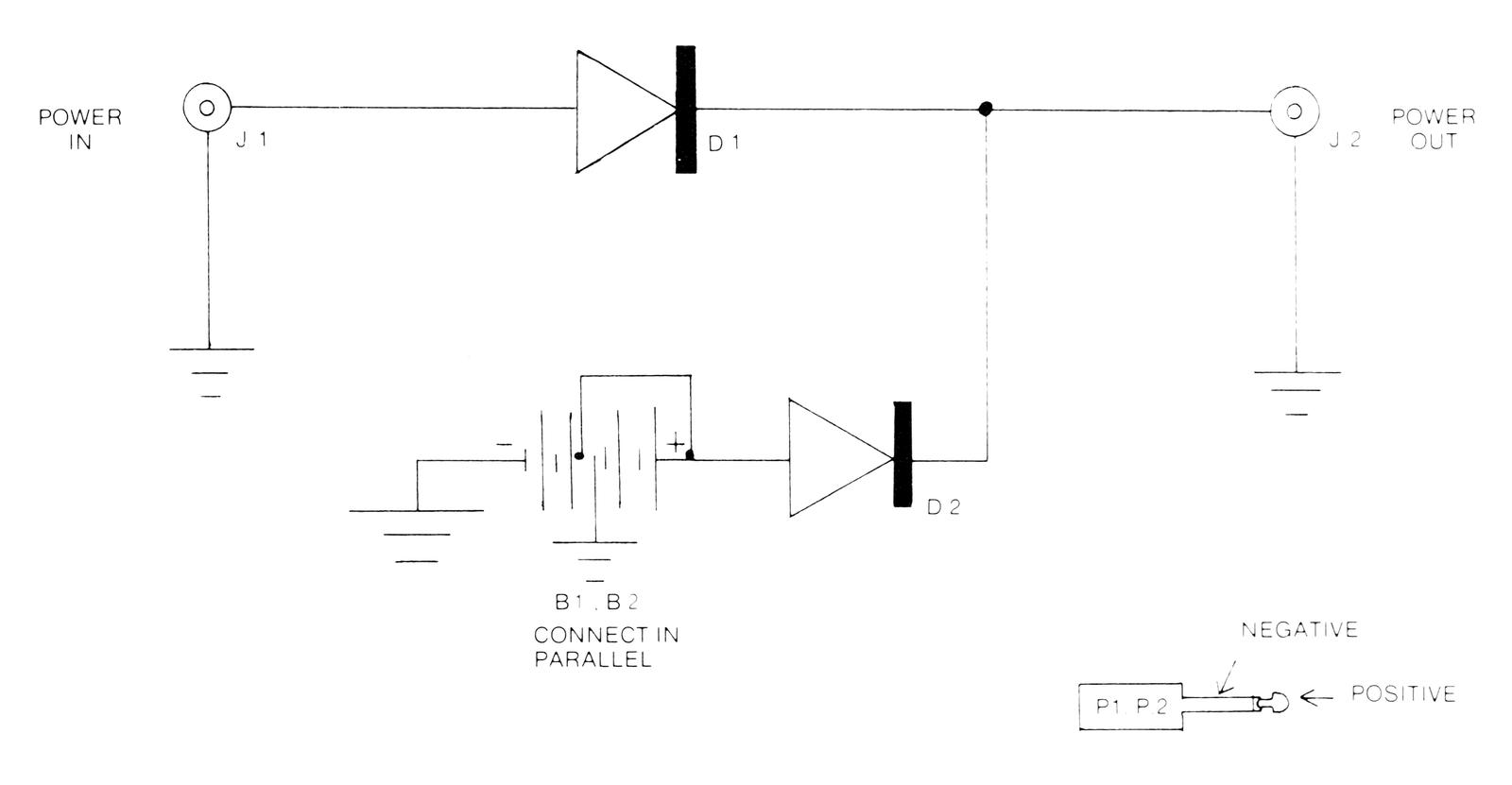
Examining the circuit in figure two, we see that Micro-Juice is somewhat similar to the block-diagramed U.P.S. system. Both sense a drop of commercial power and immediately apply an alternate power source. Micro-Juice, however is simpler and costs less, relying on 9 volt alkaline batteries, which provide power for over an hour.
The circuit is mounted in any convenient box, offering the builder the option of bypassing the two input jacks, and simply cutting the power cable from the wall-supply, feeding it directly into the cabinet. If you use this approach, make use of strain relief grommets and take careful note of polarity — the tip is positive, and the ring is negative.
After assembling the circuit and checking both the polarity of the connections for input and ouput power, and the orientation of the diodes, connect Micro-Juice to your ZX80. With the normal a.c. system in operation the cursor will be visible. When you pull the power supply from the wall outlet the ‘K’ remains.
Micro-Juice is not a portable d.c. supply capable of running the ZX80 indefinitely, but it is a fail safe device to guard your program from accidental power interruptions. Another convenience of this system is that all required parts are available at your local Radio Shack. The parts numbers are listed below.
Parts List
- 274-251 — J1, J2 two conductor, open circuit 1/8 inch phone jacks.
- 274-286 — P1, P2 two conducter, 1/8 inch phone plugs.
- 276-1101 — D1, D2 diodes, at least 50PIV,1A.
- 23-553 — B1, B2 or equivilant 9 volt akaline batteries.
- 270-233 — Cabinet, 5 1/6 X 2 5/8 X 1 5/8 inches.
- Solder
- Assorted wire