I have discovered that programs SAVED to cassette tapes from the TS-2068 can have a very high Noise/Scratch background level making verification and loading a somewhat iffy proposition. The best way to determine if you have this problem is to monitor the signal on the tape aurally during loading. The background noise can be heard before the leader and between the leader and the program. If this condition creates a problem for you, the following will provide a solution.
The TS-2068, when operated from a DC supply voltage of more than 13 volts, creates a superfluous noise on the internal power distribution lines, probably from the action of the switching voltage regulator which supplies the regulated 5 volt supply. Somehow, this noise finds its way to the SPKR/TAPE output of the SCLD chip. For some unknown reason, if the DC supply voltage is reduced to something less than 13 volts this noise disappears. I have found that a supply voltage of about 8 volts gives very good results. There are two drawbacks: At less than 15 volts you get NO COLOR output and the A&J MicroDrive will not work.
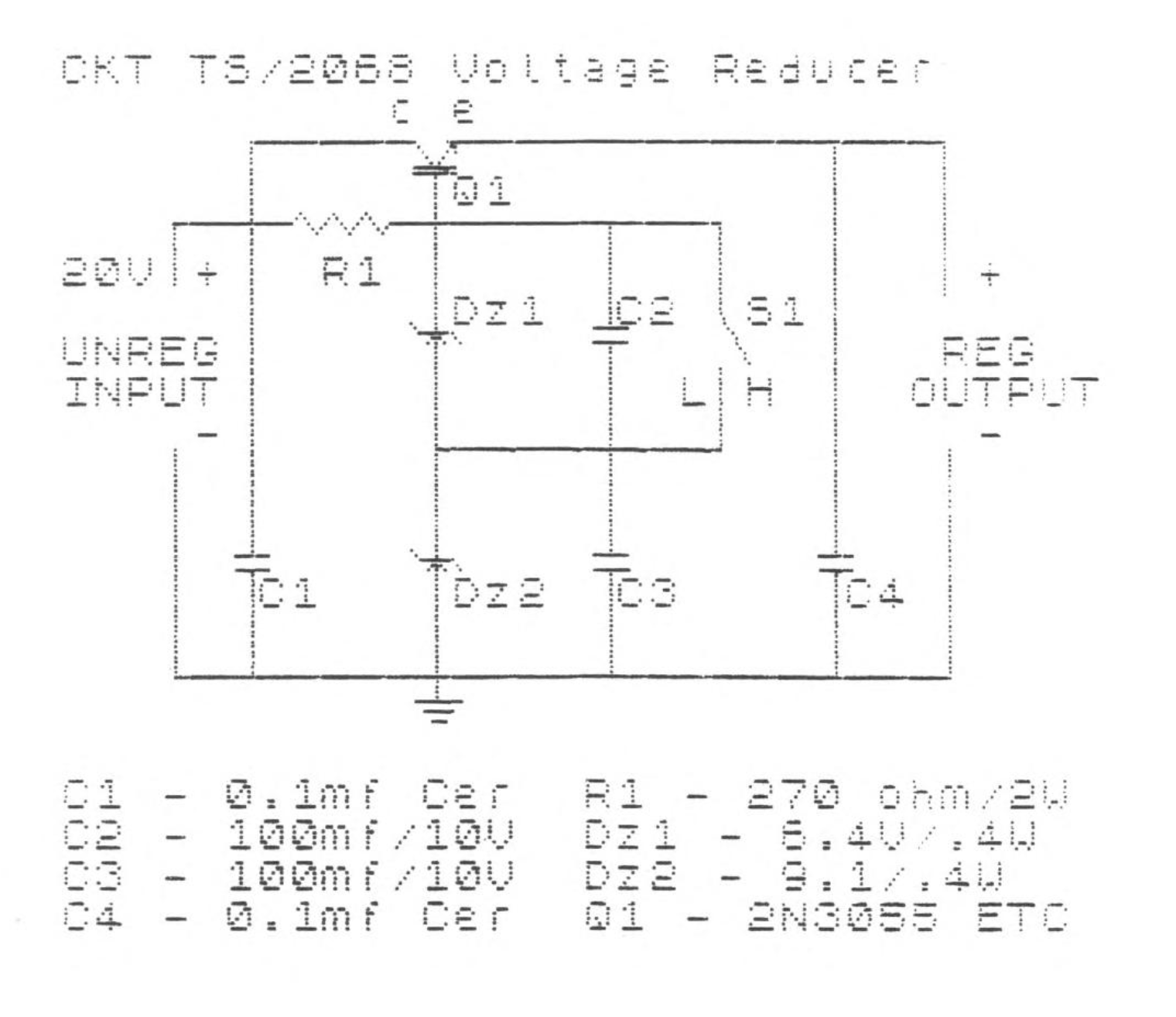
Because I sometimes wish to use the MicroDrive and the Cassette tape storage interchangeably, as in taking programs from the MicroDrive and giving them long term storage on the cheaper cassettes, I developed a voltage reducer to put in the cord of the TS-2068 power unit so that I can change the supply voltage from the normally used 15 volts to a lower 8 volts when I want to save a program to cassette tape. The supply voltage can be changed from 15 volts to 8 volts and back to 15 volts without affecting any of the program or data stored in the TS-2068 memory.
Also, by operating the TS-2068 at a normal 15-16 volt level rather than the power unit’s output of about 21 volts, the heat dissapation in the TS-2068 is reduced considerbly.
The schematic of the voltage reducer is self-explanatory. Two words of caution, however. Although the regulating transistor, 2N3055 or similar, is capable of passing many amps of current, it must be well heat-sinked as it dissipates about 5 Watts when delivering the low voltage output. When cutting the cord of the power unit, verify the polarity of the leads when they are reconnected remembering that the outer contact of the concentric connector is positive and the inner contact is negative.